


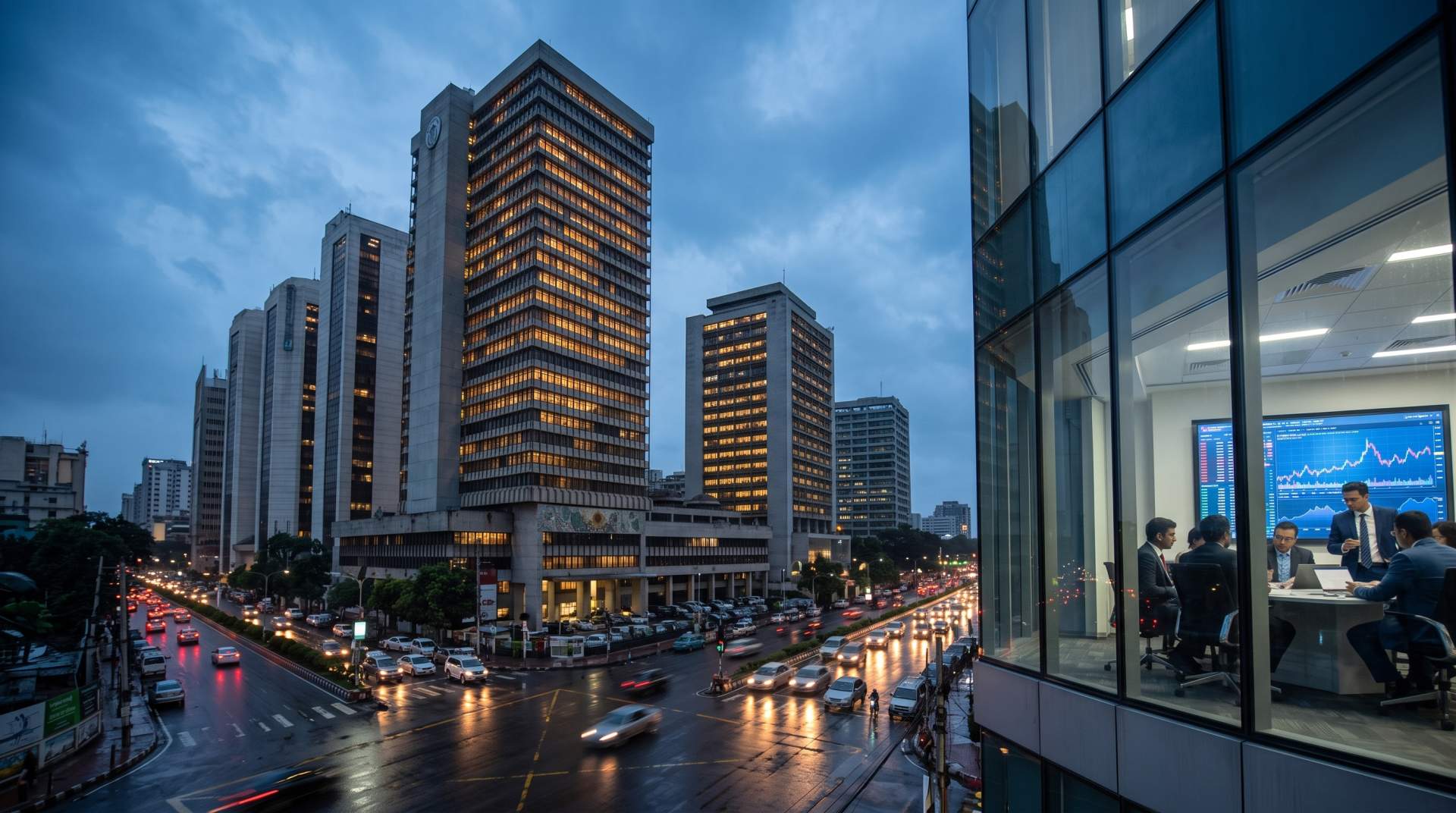
Two contrasting visions for Bangladesh banking reform collided over the span of 48 hours this week, exposing the gap between the private capital Dhaka wants to attract from abroad and the boardroom rules it is willing to enforce at home.
In New York earlier this week, Dhaka-based private equity firm mCapital Ltd unveiled an ambitious $1 billion diaspora investment framework called "Dakchhe Bangladesh" (Bangladesh is Calling). Chaired by former Bangladesh Bank governor Dr. Ahsan H. Mansur and joined at its inaugural "Invest Bangladesh" launch by Nobel laureate and former chief adviser Dr. Muhammad Yunus, the initiative aims to persuade non-resident Bangladeshis (NRBs) across 100 global cities to channel their savings into three specialized private equity funds, including a dedicated vehicle to buy up and resolve defaulted bank loans.
Back in Dhaka on Friday, October 2, however, the Financial Institutions Division (FID) of the Ministry of Finance moved in the opposite direction. Officials confirmed that the ministry has watered down Bangladesh Bank’s draft amendments to the Bank Company Act, rejecting the central bank’s proposal to cut the maximum number of bank directors from a single family from three to two, and refusing a plan to slash consecutive director terms from 12 years to six.
Together, the two developments capture the central dilemma facing Bangladesh’s financial system in October 2026. Cleaning up a banking sector buried under Tk 6.07 trillion ($50 billion-plus) in bad loans requires billions of dollars in fresh institutional and diaspora capital. Yet convincing outside investors to buy into Bangladeshi financial assets depends on proving that the era of politically connected "family banks" is truly over.
The Tk 6.07 Trillion Bad-Loan Mountain
To understand why private equity firms and policymakers are talking about distressed-asset funds in the first place, look at the balance sheets of Bangladesh’s commercial lenders.
For more than a decade prior to late 2024, the true scale of defaulted loans in Bangladesh was masked by lenient loan rescheduling rules, special regulatory moratoriums, and disguised accounting. When strict international asset-quality audits and central bank classification rules were finally enforced over the past two years, hidden defaults surfaced all at once.
According to Bangladesh Bank data cross-referenced against the International Monetary Fund’s (IMF) Financial Soundness Indicators, Bangladesh now holds the highest non-performing loan (NPL) ratio in the world. A non-performing loan is a bank loan where the borrower has stopped making scheduled interest or principal payments for a specified period, typically 90 days or more.
By the end of June 2026, total non-performing loans in Bangladesh’s banking system reached Tk 6,06,555 crore (Tk 6.07 trillion), representing 32.78 percent of all loans disbursed by banks. That figure climbed by Tk 17,851 crore in just three months from the Tk 5,88,704 crore (32.3 percent) recorded in March 2026, though it sits slightly below the all-time peak of Tk 6,44,515 crore (35.7 percent) hit in September 2025.
Country / Financial Metric | Non-Performing Loan (NPL) Ratio | Data Period & Context | Source Authority |
Bangladesh (Total Banking Sector) | 32.78% (Tk 6.07 trillion) | June 2026 (Up from 32.3% in March 2026; peak was 35.7% in Sept 2025) | Bangladesh Bank / IMF comparison |
Bangladesh (Five Merged Troubled Banks) | >80.0% | Mid-2026 (Follows forensic audits of anonymous and fraudulent loans) | Bangladesh Bank disclosures |
Chad | 31.51% | Latest available IMF Financial Soundness figure (Dec 2023 baseline) | International Monetary Fund (IMF) |
Equatorial Guinea | 30.00% | Latest regional comparison (Down from 32.5% in 2023) | African Development Bank / IMF |
Algeria | 20.05% | December 2025 | International Monetary Fund (IMF) |
Ghana | 18.11% | Q1 2026 (Down from 20.6% in 2023) | International Monetary Fund (IMF) |
Having nearly Tk 33 out of every Tk 100 in bank credit frozen in default cripples the everyday economy. Because banks must set aside huge cash provisions to cover bad loans, they have less capital to lend to legitimate factories and small businesses, keeping borrowing costs high even for healthy companies.
The rot is even deeper inside non-bank financial institutions (NBFIs) and the five weak banks recently merged under regulatory supervision, where more than 80 percent of disbursed loans are classified as non-performing. At troubled lender Prime Finance & Investment Limited (PFIL), thousands of elderly and retired depositors are still struggling to withdraw their life savings for medical care and daily expenses; on October 1, Bangladesh Bank Executive Director Arief Hossain Khan warned that PFIL could face formal liquidation after failing to meet repayment conditions, potentially following four other failed financial institutions into wind-down.
How the $1 Billion Diaspora Framework Aims to Work
Against that backdrop of frozen liquidity, mCapital’s $1 billion "Dakchhe Bangladesh" framework is trying to change how overseas Bangladeshis send money home.
Historically, remittances from expatriate workers have operated strictly as household consumption transfers. An overseas worker in Saudi Arabia, the United Arab Emirates, the United Kingdom, or the United States sends cash home via a bank or mobile wallet, and their family in Bangladesh spends it on food, tuition, healthcare, or rural housing construction.
While those transfers keep millions of families afloat, monthly flows have begun to lose momentum. According to Bangladesh Bank figures released on October 1, remittance inflows dropped to an 11-month low of $2.76 billion in September 2026, marking the fourth straight month below the $3 billion threshold as the Middle East conflict, rising overseas living costs, and a five-year low in annual worker departures (9.7 lakh in FY26) weighed on monthly transfers.
Instead of treating expatriates solely as remitters of family cash, mCapital wants to turn white-collar professionals, doctors, engineers, and diaspora entrepreneurs across 100 cities into direct institutional equity owners. Under the framework unveiled in New York, investments will be channeled through three specialized funds:
The Distressed Asset Management Fund: Designed to buy non-performing loans and stressed corporate assets at a discount, restructure viable factories or real estate collateral, and recover value while helping banks clean up their balance sheets.
The Financial Services Fund: Targeting fintech expansion, structural banking transformation, and Sharia-compliant digital banking platforms—a sector gaining momentum after Bangladesh Bank granted approval to five new digital bank ventures, including platforms backed by bKash and Robi.
The Healthcare Impact Fund: Focusing on hospital infrastructure, a proposed "Healthcare City," nursing education, and digital telemedicine through the Shukhee Platform in collaboration with Grameen.
To reassure diaspora investors who have long feared losing money to local fraud or currency traps, mCapital structured the funds with dual domestic and international legal compliance, independent advisory boards, a mandatory two-year lock-in period, and BRAC Bank serving as the official institutional trustee and custodian. Rather than pooling blind cash into an unregulated cooperative, individual diaspora members retain legal ownership of regulated assets in their own names while remaining responsible for their own investment due diligence.
Why Softening the Bank Company Act Threatens the Pitch
The timing of mCapital’s New York roadshow highlights a sharp policy contradiction in Dhaka. For a Distressed Asset Management Fund or a Financial Services Fund to work, investors need confidence that the banking rules that created the Tk 6.07 trillion bad-loan crisis will not simply repeat themselves under new political sponsors.
During his tenure as governor of Bangladesh Bank before stepping down earlier this year, Ahsan H. Mansur championed strict amendments to the Bank Company Act to break the grip of entrenched business families over private commercial banks. In its draft sent to the government, Bangladesh Bank proposed two core guardrails:
Cutting family representation: Reducing the maximum number of directors from a single family on a bank’s board from three to two.
Halving consecutive tenure: Slashing a director’s maximum continuous term from 12 years back down to six years (reversing the 2018 and 2023 legal changes that had doubled terms from six to 12 years).
Following pushback from the Bangladesh Association of Banks (BAB)—the powerful lobby group representing private bank owners, which argued that cutting terms to six years would deprive boards of experienced leadership—the Finance Ministry’s Financial Institutions Division rejected both central bank proposals this week.
Under the revised draft ordered by the ministry on October 2, a single family will still be allowed to hold three director seats on a bank board, and continuous tenure will only be trimmed slightly from 12 years to nine years. Furthermore, officials indicated that rules governing directors tied to defaulted loans are being relaxed, no ownership cap is being placed on "strategic investors," and Bangladesh Bank’s power to dissolve a corrupt or failing bank board is being altered to favor appointing an administrator while leaving the existing board in place.
Speaking to The Business Standard on Friday, Mansur warned bluntly that watering down Bangladesh banking reform risks handing the banking system from one set of politically connected oligarchs to another. If the strict governance amendments are dropped, he cautioned, banks that were previously captured by businesses aligned with the former Awami League administration will simply become "family banks" controlled by business groups backed by the current ruling Bangladesh Nationalist Party (BNP). He also questioned why the Financial Institutions Division—a ministry wing whose abolition was previously promised to protect central bank independence—continues to override the banking regulator’s technical drafts.
The Macroeconomic Squeeze Behind the Scenes
This governance tug-of-war is playing out at a moment when Bangladesh’s broader economy has very little margin for error.
As BANGLADESHIST examined earlier this weekend in our report on how Bangladesh coal power overtook gas generation, Bangladesh Bank used its inaugural quarterly monetary policy statement on September 30 to hold its benchmark policy rate steady at 9.50 percent. With headline inflation still elevated at 8.26 percent in August and retail diesel and octane prices jumping Tk 20 per liter on September 20, the central bank cannot afford to print cheap money to bail out troubled lenders or state institutions like the Investment Corporation of Bangladesh (ICB), which recently sought a Tk 10,000 crore rescue fund.
At the same time, the government is cutting back its own domestic bank borrowing to avoid crowding out private businesses, announcing plans on October 1 to borrow Tk 30,107 crore through treasury bills and bonds in the October–December quarter (down from more than Tk 35,000 crore in the July–September quarter) while preparing to negotiate a new $5 billion IMF program. Meanwhile, as we noted in our coverage of why Chattogram Port terminals are moving toward global operators, Dhaka is increasingly looking to foreign private capital and public-private partnerships to fund infrastructure upgrades that the state budget can no longer carry alone.
To keep export sectors moving while commercial banks remain bogged down in bad loans, Bangladesh Bank did issue a circular on October 1 expanding its Export Facilitation Pre-finance Fund (EFPF) refinance scheme from Tk 5,000 crore to Tk 7,000 crore, though it simultaneously raised the borrowing interest rate under the scheme to 6 percent.
What Must Happen Before Parliament Votes
The softened Bank Company Act amendment is now scheduled to go through Law Ministry vetting and cabinet committee review before being tabled in the next session of Parliament. Between now and that parliamentary vote, the credibility of Bangladesh banking reform rests on three practical tests:
Restore central bank autonomy over board governance: If Parliament wants foreign and diaspora private equity funds to inject billions of dollars into Bangladeshi banks and distressed assets, lawmakers must strip out loopholes for defaulting directors and give Bangladesh Bank uncompromised statutory authority to remove failing boards without interference from the Financial Institutions Division.
Build a legal framework for distressed asset sales: For mCapital’s Distressed Asset Management Fund—or any international distressed-debt investor—to buy and resolve non-performing loans at scale, Bangladesh needs modern bankruptcy courts and clear secondary-market rules under the Money Loan Court Act (Artha Rin Adalat Ain) so buyers can legally take over, restructure, or liquidate defaulted collateral without spending a decade in litigation.
Protect small depositors while punishing wilful defaulters: As Finance Minister Amir Khosru Mahmud Chowdhury noted on Saturday, restoring public confidence in the banking system is the government’s top financial priority. Doing so requires fast-tracking deposit insurance payouts for trapped savers at institutions like Prime Finance while prosecuting the insiders who siphoned off loans in the first place.
Non-resident Bangladeshis sent home $8.59 billion in the first quarter of FY2026–27 alone, proving that the diaspora’s financial commitment to the country remains deep. Whether that diaspora is willing to move beyond monthly family wire transfers and commit $1 billion into long-term Bangladeshi equity will depend on a simple question: when an expat in New York or London invests in Dhaka’s financial sector, is their money protected by an independent regulator, or is it still at the mercy of the family boardroom?

Comments
0