


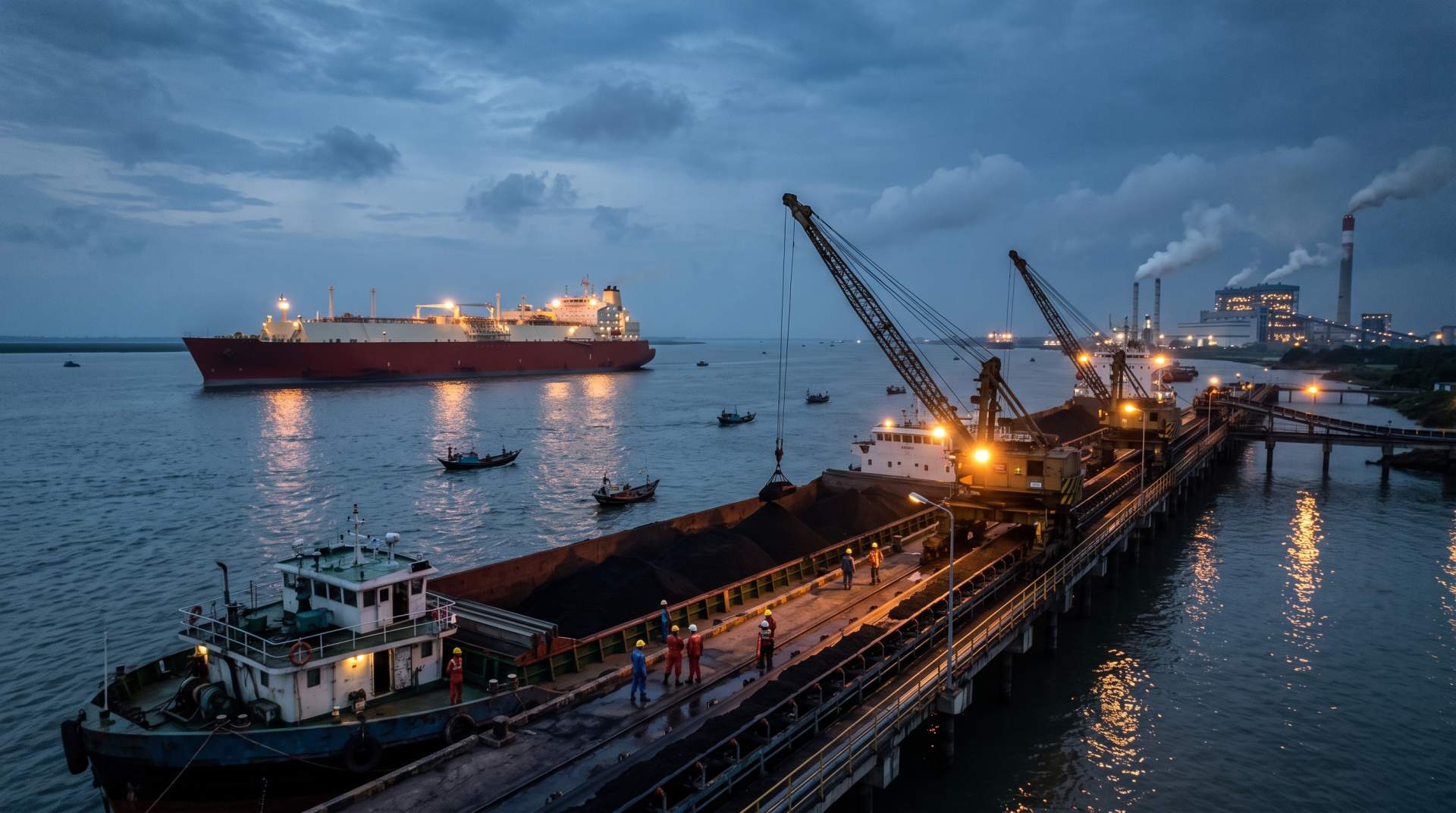
For decades of Bangladesh Coal Power, natural gas was the undisputed backbone of Bangladesh’s economy. At its peak, domestic gas fields generated more than 90 percent of the nation’s electricity, firing the captive boilers of textile mills in Gazipur and keeping the lights on across Dhaka. When those onshore gas reserves began to run dry in the late 2010s, global energy exporters saw an obvious successor: liquefied natural gas (LNG), super-cooled methane shipped by sea.
That script just broke. During the peak summer cooling months of 2026, Bangladesh coal power overtook gas-fired electricity generation on a monthly basis for the first time on record, according to electricity generation data tracked by the energy think tank Ember and reported by Reuters and The Daily Star on October 2.
The crossover is more than a domestic utility statistic. Across the global energy industry, multibillion-dollar LNG export terminals are currently under construction in the United States, Qatar, and elsewhere on the assumption that fast-growing, gas-short economies in South and Southeast Asia will absorb the new supply. Instead, Bangladesh’s summer fuel switch demonstrates what happens when geopolitical price shocks collide with the fiscal limits of a developing economy: when imported gas gets too expensive, price-sensitive buyers burn coal instead.
How a $24-Per-MMBtu Shock Priced Gas Out of the Grid
To understand why utilities in Dhaka pivoted away from gas this summer, look at the invoice for a single tanker of imported fuel.
Throughout 2026, the war involving the United States, Israel, and Iran has severely disrupted maritime energy traffic through the Strait of Hormuz, a narrow waterway that normally handles roughly 20 percent of global LNG trade and 25 to 30 percent of global oil shipments. For Bangladesh, the chokepoint crisis hit home directly. QatarEnergy, Dhaka’s largest long-term supplier, reduced its scheduled 2026 deliveries after conflict-related damage to its LNG infrastructure, forcing state-owned oil and gas corporation Petrobangla to hunt for replacement shipments on the open spot market.
Spot LNG is priced in US dollars per million British thermal units (MMBtu), a standard measurement of heat content. Before the war escalated, Bangladesh bought spot LNG cargoes for roughly $10 to $12 per MMBtu, working out to about Tk 410 crore to Tk 490 crore per shipment.
By late August, when the Cabinet Committee on Government Purchase approved two spot cargoes for September 2026 delivery one from South Korea’s Posco International at $24.625 per MMBtu and another from the UK arm of TotalEnergies at $24.25 per MMBtu, the price had more than doubled. With each tanker carrying roughly 33.6 lakh MMBtu of gas, a single shipment now costs the Bangladeshi exchequer around Tk 1,000 crore. Between March and late August alone, Bangladesh had to purchase 35 spot cargoes under these tightened market conditions, according to commodity analytics firm Kpler.
Faced with paying Tk 1,000 crore per boatload of gas or rationing electricity during sweltering monsoon heatwaves, grid operators leaned heavily on the coal-fired power stations built over the past several years at Payra, Rampal, Matarbari, and Banshkhali, alongside cross-border coal power imported from India. Even though coal carries its own import bills and environmental costs, its cost per megawatt-hour of generated electricity remained substantially lower than spot LNG.
Inside Bangladesh Coal Power and the 2026 Grid Mix
On paper, Bangladesh still looks like a gas-first power system. According to official Bangladesh Power Development Board (BPDB) generation data as of October 2026, gas-fired plants account for 12,472 megawatts (MW) or 42.15 percent, of the country’s 29,593 MW total installed grid capacity. Coal sits in second place at 8,423 MW, representing 28.46 percent of installed capacity, followed by heavy fuel oil (HFO) plants at 5,641 MW (19.06 percent).
The gap between installed capacity and actual electricity generated highlights the structural trap inside Bangladesh’s power sector. Building a gas-fired power station is relatively quick and inexpensive compared with building a coal or nuclear plant, which is why successive energy plans added thousands of megawatts of gas turbines. Yet a turbine cannot spin without fuel. When domestic gas wells decline and Petrobangla cannot afford to keep floating storage and regasification units (FSRUs) operating at full tilt with $24 spot cargoes, a large portion of that 12,472 MW gas fleet sits idle or runs below capacity.
Meanwhile, Bangladesh’s 8,423 MW of coal plants were built as large baseload stations designed to run around the clock. When dispatched near full utilization, despite occasional maintenance outages and coal procurement bottlenecks earlier in the year, those plants can generate more monthly kilowatt-hours than a larger fleet of fuel-starved gas turbines.
Why LNG Exporters Are Worried About Emerging Asia
For global gas producers in Houston and Doha, Bangladesh’s pivot is an uncomfortable warning sign.
The investment case for the next wave of global LNG supply relies heavily on emerging Asian nations, specifically Bangladesh, Pakistan, Vietnam, and the Philippines. Why? Because traditional gas buyers in the developed world are no longer expanding their consumption:
Europe’s gas demand is projected to plateau and decline as wind, solar, and heat pumps replace Russian pipeline gas and temporary crisis LNG imports.
Japan and South Korea, historically the anchor buyers of Asian LNG, are turning back toward nuclear and renewable power. Both countries currently have more new nuclear generation capacity under construction than gas-fired capacity, according to data from Global Energy Monitor (GEM).
China, despite being the world’s largest LNG importer by volume, prioritizes domestic coal and massive domestic renewable buildouts for its power grid; Ember data shows natural gas accounts for only about 3 percent of China’s total electricity generation in 2026.
That leaves developing South and Southeast Asian economies as the indispensable growth engine for LNG exporters in the late 2020s and 2030s. Yet these countries are also the most sensitive to price swings. Unlike utilities in Tokyo or Frankfurt, state power boards in Dhaka or Islamabad cannot easily pass a 100 percent surge in fuel costs onto household and industrial consumers without triggering severe inflation, factory closures, or sovereign foreign-exchange strain.
Nor is the pressure confined to natural gas. Global distillate and oil markets have tightened sharply in 2026 alongside the Middle East conflict and reduced refining activity in Russia and China. On October 2, the Group of Seven (G7) nations announced an immediate coordinated release of 100 million barrels of oil and diesel reserves through the International Energy Agency (IEA) over four months, frontloading diesel supplies within the first 20 days, after US diesel prices surged and Washington briefly threatened to ban American diesel exports. For an import-dependent country like Bangladesh, which already had to authorize emergency purchases of 300,000 tonnes of diesel earlier this year, the lesson is clear: liquid and gaseous fossil fuels carry acute geopolitical price risk.
The Ripple Effect on Factories, Inflation, and Monetary Policy
Inside Bangladesh, the tug-of-war between gas and coal hits the real economy across three channels: industrial production, inflation, and climate trade rules.
First, while coal can substitute for gas on the national electricity grid, it cannot easily replace piped natural gas inside Bangladesh’s export factories. Readymade garment (RMG) dyeing, washing, and textile spinning mills rely directly on gas pressure to run captive generators and industrial boilers. According to Export Promotion Bureau (EPB) figures released on October 1, Bangladesh’s merchandise exports rose 8.54 percent year-on-year in September 2026 to $3.93 billion, led by an 8.56 percent rebound in garment shipments to $3.08 billion. Maintaining that recovery requires reliable, affordable energy; when Petrobangla rations gas to manage spot LNG costs, factories are forced to burn expensive diesel or absorb costly production delays.
Second, imported energy costs are directly constraining macroeconomic policy. On September 30, Bangladesh Bank issued its first-ever quarterly monetary policy statement shifting away from its traditional six-month schedule to respond faster to economic shocks and kept its benchmark policy interest rate unchanged at 9.50 percent for the October–December 2026 quarter. Although headline inflation eased slightly to 8.32 percent in July and 8.26 percent in August according to the Bangladesh Bureau of Statistics (BBS), the central bank explicitly warned that elevated global fuel and fertilizer prices caused by the Middle East conflict remain a major threat to price stability. Much like the global semiconductor memory crunch that has driven up local smartphone assembly costs this year, imported energy inflation leaves domestic policymakers with very little room to cut interest rates for local businesses.
Third, relying on coal to escape high LNG prices creates a longer-term carbon headache. As Bangladesh prepares for post-Least Developed Country (LDC) trade realities and stricter environmental standards from European Union apparel buyers, a power grid that leans harder on coal increases the carbon footprint of every shirt and pair of trousers manufactured using grid electricity.
Can Dhaka Escape the Fossil Import Trap?
Long-term energy planners in Dhaka are still betting that LNG prices will eventually cool once new global export terminals come online later this decade. Petrobangla is moving ahead with plans for two additional LNG import terminals by 2030, projecting that Bangladesh will need an extra 3 to 4 million tonnes per annum (mtpa) of LNG between 2026 and 2030, on top of the nearly 7 million tonnes imported last year and potentially 17 to 18 mtpa between 2031 and 2040.
Yet the events of 2026 have emboldened energy economists who argue that trading one imported fossil fuel (LNG) for another (coal) only shifts the vulnerability from gas tankers to coal bulk carriers.
The domestic alternative grid-connected solar and wind has historically lagged behind Bangladesh’s famous off-grid Solar Home System (SHS) program, which installed more than 6.5 million rural units after 2003. While BPDB’s core grid solar capacity stood at 797 MW as of October 2026, broader renewable energy capacity across the power sector has reached roughly 1,852 MW, or about 5.7 percent of the sector total.
Signs of a policy shift are beginning to emerge. On October 1, Prime Minister Tarique Rahman inaugurated 960.8 kilowatts of grid-tied rooftop solar systems across government buildings in three upazilas of Feni Chhagalnaiya, Parshuram, and Fulgazi implemented by the Bangladesh Rural Electrification Board (BREB) to feed surplus power into the national grid. At the national level, while the Renewable Energy Policy 2025 set targets of meeting 20 percent of power demand from renewables by 2030 and 30 percent by 2040, the government is now weighing a more aggressive plan to reach roughly 10,000 MW of renewable capacity by 2030.
Whether Dhaka can upgrade its grid transmission lines, land policies, and battery storage fast enough to hit 10,000 MW in four years remains an open question. Until it does, Bangladesh’s summer coal surge will stand as a stark reminder to both local planners and global gas executives: in emerging Asia, the energy transition is still governed by the ruthless arithmetic of what a country can afford to burn today.

Comments
0