


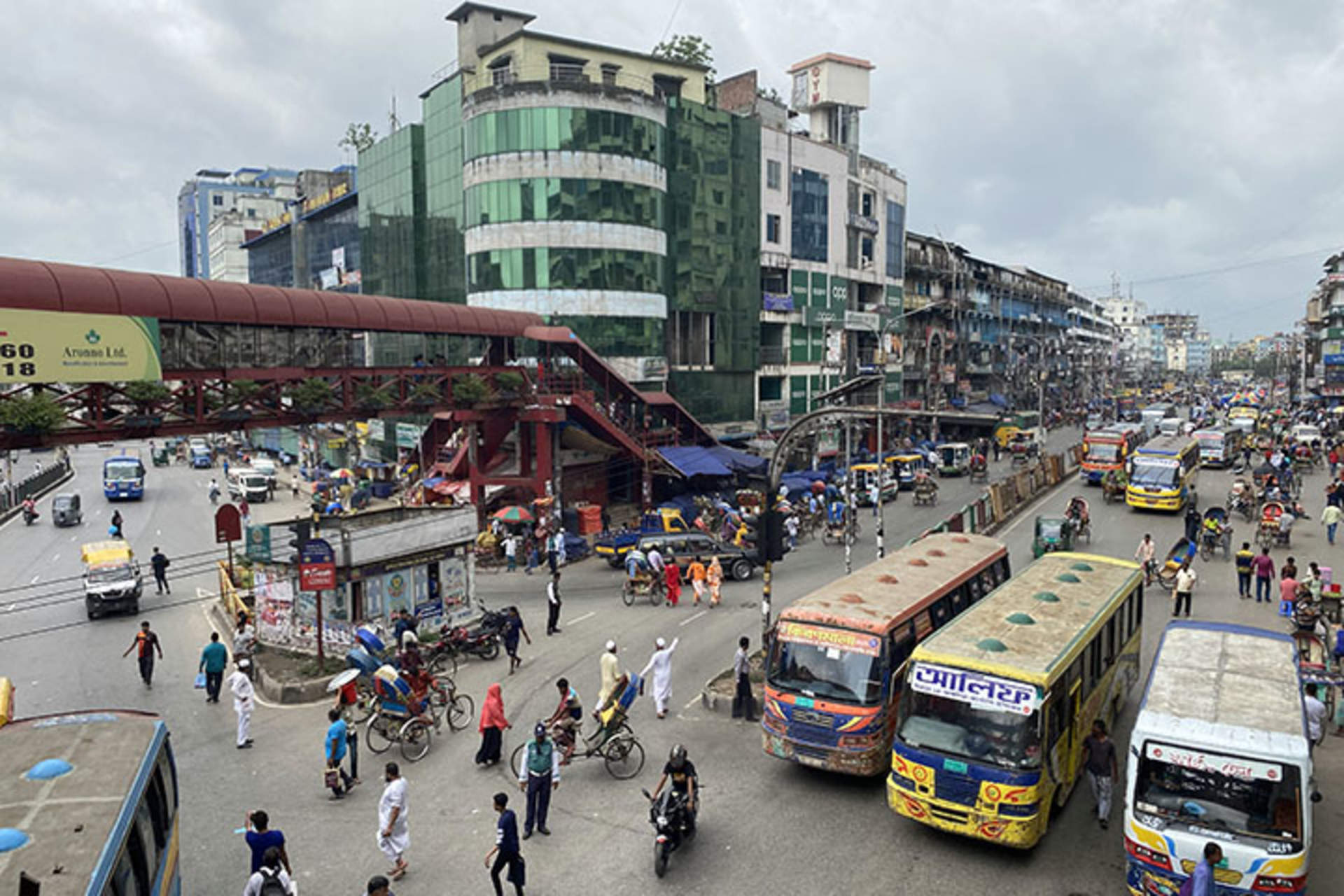
Bangladesh’s road safety crisis is taking a toll far beyond the number of crashes reported each day. A national health injury survey estimated that 24,233 people die from road traffic injuries annually, while 38,028 people are left permanently disabled. The figures translate to roughly 66 deaths and 104 cases of permanent disability every day.
The findings, reported by The Daily Star in October 2025, draw attention to a serious public-health problem: road crashes are not only killing people but also leaving thousands of survivors with lasting physical, social and economic consequences.
The survey, titled Prevalence and Risk Factors for Mortality and Morbidity in Relation to National Health Injury Survey of Bangladesh 2022–23, was commissioned by the Directorate General of Health Services. The Centre for Injury Prevention and Research Bangladesh conducted the research with technical support from the World Health Organization and the Bangladesh Bureau of Statistics.
The study was carried out between May 2023 and February 2024, involving approximately 443,000 participants.
Its estimates require careful interpretation. Government administrative figures, road-safety organisations’ reports and international estimates use different methods and do not produce identical totals. However, the survey highlights a level of harm that cannot be understood through reported crash cases alone.
Why are so many people dying on Bangladesh’s roads?
More vehicles, but safety has not kept pace
Economic growth has brought new roads, more vehicles and greater mobility to Bangladesh. But building roads and increasing transport capacity do not automatically make travel safer.
According to findings reported by The Daily Star, the survey’s principal investigator, Salim Mahmud Chowdury, linked the rise in road fatalities to economic development and the growth in roads and vehicles without an effective mechanism to control crashes.
This points to a central weakness in transport planning. Infrastructure expansion must be accompanied by safe road design, effective traffic management, vehicle inspections and consistent enforcement of traffic laws.
Without these measures, greater mobility can also mean greater exposure to danger.
Unfit vehicles and gaps in driver training
Road safety experts and campaigners have identified unfit vehicles, shortages of skilled drivers and weak enforcement as important problems in Bangladesh’s transport sector.
A vehicle with defective brakes, worn tyres, faulty lights or other mechanical problems can become a serious hazard, particularly at high speeds or on busy roads. Poor maintenance also increases the risk that a driver will lose control in an emergency.
Driver competence matters just as much. Safe driving requires more than the ability to operate a vehicle. Drivers must judge speed and distance, recognise hazards, respect pedestrians and respond appropriately when traffic conditions change.
Commercial drivers may also face pressure to complete journeys quickly. Where working conditions, scheduling and oversight reward speed over safety, dangerous driving practices become harder to prevent.
These factors should not be treated as proof that every crash has the same cause. Each incident requires evidence-based investigation. But they identify areas where stronger oversight can reduce risks.
Speeding turns mistakes into deadly crashes
Speed is one of the clearest established risk factors in road traffic injuries.
The World Health Organization explains that higher average speeds increase both the likelihood of a crash and the severity of the resulting injuries. Its road traffic guidance estimates that every 1% increase in mean speed is associated with a 4% increase in fatal crash risk.
This matters especially where pedestrians, cyclists, motorcycles, buses and heavy vehicles share road space.
A driver travelling too fast has less time to react to a person crossing the road, a vehicle changing lanes or an unexpected obstruction. Even when a collision cannot be avoided, lower speeds can reduce the force of impact and the likelihood of death or permanent injury.
Speed management therefore needs to go beyond occasional enforcement drives. Appropriate speed limits, visible enforcement, safer junctions and road designs that encourage drivers to slow down can work together to reduce risk.
Pedestrians and motorcyclists need safer roads
Roads must be designed for everyone who uses them, not only for motor vehicles moving quickly.
Pedestrians face particular danger when footpaths are missing, crossings are poorly positioned or traffic moves at high speed near homes, schools, markets and public transport stops.
Motorcyclists are also vulnerable because they have less physical protection than occupants of cars or buses. Helmet use, safe riding practices, appropriate speeds and better road surfaces can reduce the risk of severe injury.
The WHO identifies pedestrians, cyclists and motorcyclists as vulnerable road users who account for a substantial share of road deaths worldwide.
For Bangladesh, this means that road-safety planning must consider how people actually travel. A road may move vehicles efficiently while remaining dangerous for someone walking to work, taking a child to school or crossing to reach a bus stop.
Weak enforcement undermines traffic laws
Rules alone cannot guarantee safety. They must be applied consistently.
Speed limits, helmet requirements, seat-belt rules, vehicle fitness standards and licensing requirements can reduce risk when they are properly enforced. Inconsistent enforcement, by contrast, can allow dangerous behaviour to continue.
Effective enforcement also requires accountability. Vehicle inspections must identify real safety problems, licensing systems must assess driving competence, and investigations into fatal crashes must establish what happened and whether preventable failures contributed.
Authorities should publish reliable data on crashes, deaths and serious injuries, making it possible to assess whether interventions are working.
Why the figures are difficult to compare
Bangladesh does not have a single road-fatality figure that can be interpreted without considering how it was produced.
The national injury survey estimated 24,233 annual road-crash deaths. The Daily Star reported that police and Bangladesh Road Transport Authority figures put the annual toll at around 5,000 to 6,000, while non-governmental organisations produced higher estimates. The WHO’s Global Status Report on Road Safety 2023 estimated 31,578 road deaths in Bangladesh in 2021.
These figures cover different periods and use different collection and estimation methods. They should not be treated as direct measurements of the same year's events.
Police and administrative records depend on crashes being reported and deaths being documented. Surveys and international estimates use different approaches to capture deaths that may not appear in administrative data.
The differences reinforce the need for a more complete and transparent national road-safety information system. Better records would help authorities identify high-risk roads, understand the circumstances of crashes and direct resources towards the interventions most likely to save lives.
What Bangladesh needs to change
Reducing road deaths requires action across the transport system rather than relying on public-awareness campaigns alone.
First, authorities need regular and credible vehicle fitness checks, effective licensing and stronger oversight of commercial transport. Enforcement should focus on measurable safety risks and apply consistently.
Second, road design must protect vulnerable users. Footpaths, safe crossings, appropriate speed limits, safer junctions, road lighting and protective measures at high-risk locations should be treated as core infrastructure rather than optional additions.
Third, traffic laws must be enforced in ways that change behaviour. Speeding, dangerous overtaking, unsafe motorcycle use and violations of vehicle safety requirements need consistent responses supported by reliable monitoring.
Fourth, crash investigations and public reporting should improve. Authorities need to know where crashes occur, who is affected, what contributed to each incident and whether emergency services reached victims quickly enough.
Finally, emergency medical response and rehabilitation deserve greater attention. Preventing a crash is the first priority, but timely treatment can influence whether a seriously injured person survives or experiences lasting disability. Survivors may also need long-term rehabilitation and support to return to work and daily life.
Road safety is a public responsibility
The estimate of 66 deaths and 104 permanent disabilities a day should not be read as a precise daily count of newly recorded victims. It is an annual survey estimate expressed as a daily average. Even with that distinction, the scale of the reported burden is alarming.
Every fatal crash represents a life lost; every disabling injury can reshape the future of an individual and an entire family. The consequences extend to household income, healthcare needs, employment and the wider economy.
Bangladesh's response must therefore move beyond treating crashes as isolated events. Safer roads, safer vehicles, responsible driving, effective enforcement and reliable emergency care are interconnected parts of the same system.
The central question is not simply why crashes keep happening. It is why preventable risks remain on the roads, and whether the institutions responsible for transport can turn established safety measures into consistent practice.
Comments
0