


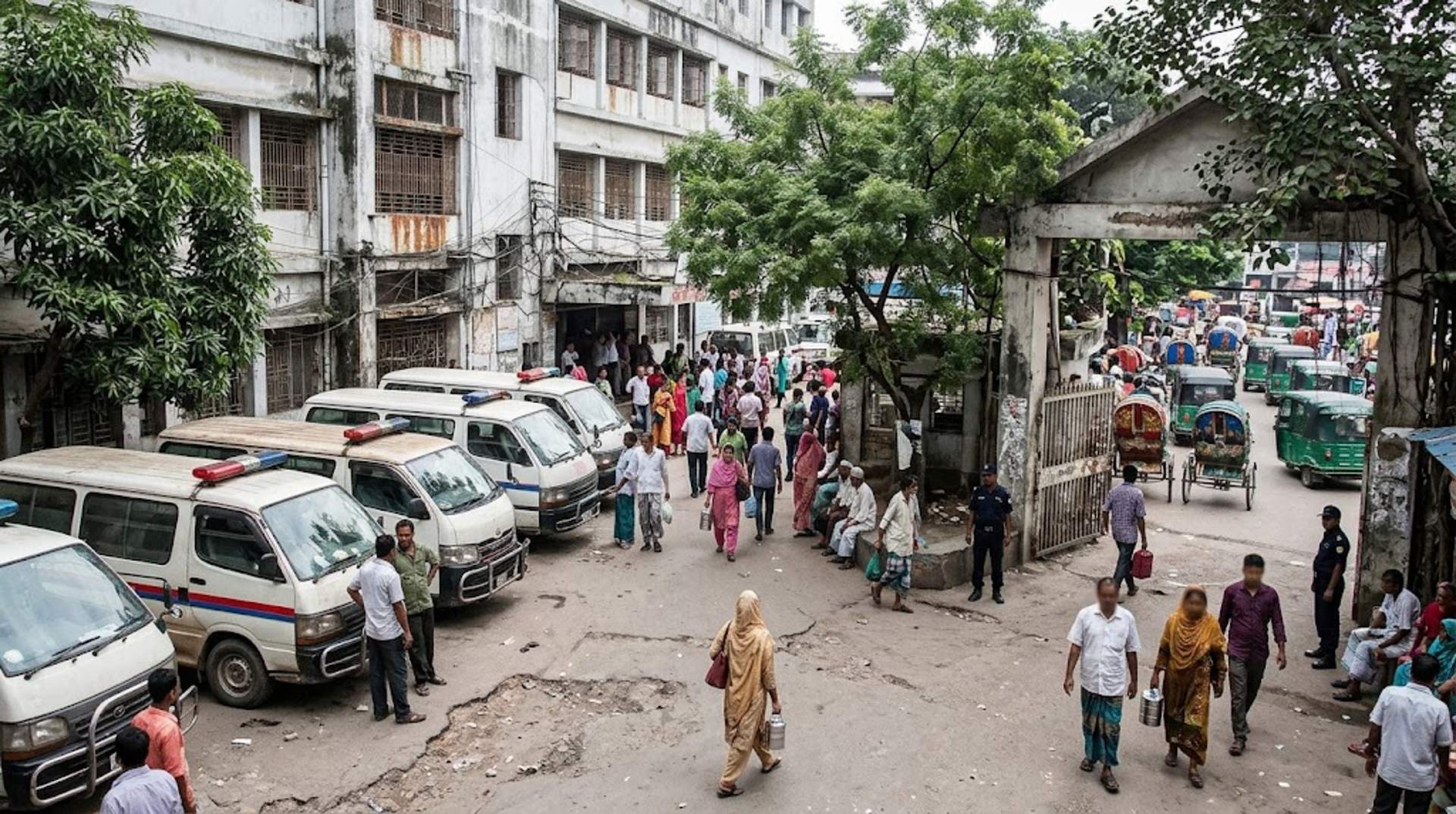
Private ambulance operators at Dhaka Medical College Hospital (DMCH) entered their second day of an indefinite strike on Wednesday, October 28, disrupting patient transfers and leaving families struggling to arrange transport for critically ill patients and deceased relatives.
The strike began on Tuesday after hospital authorities removed private ambulances from their previous parking areas. Operators are demanding designated parking facilities, while hospital officials say limited space makes permanent parking inside the premises impractical.
The dispute has exposed a difficult question for one of Bangladesh’s busiest public hospitals: how can authorities maintain order and manage congestion without making essential transport harder for patients?
Why have ambulance operators stopped working?
Members of the DMCH unit of the Private Ambulance Owners Welfare Association say they previously parked their vehicles inside hospital grounds while providing transport for patients.
According to reports by The Business Standard and The Daily Star, operators objected after the hospital discontinued those arrangements. They say parking on nearby roads exposes drivers to traffic congestion and the risk of fines, making it difficult to continue operating from the hospital.
The operators have said they will continue the strike until an acceptable parking arrangement is made.
Hospital director Brigadier General AKM Farhad Hossain has rejected the demand for permanent parking inside the premises. He has cited a shortage of space and the need to reduce congestion near the emergency department.
Hospital authorities have also argued that ambulances should be allowed to enter to drop off patients and return when required to collect them, rather than remain parked inside the grounds.
The two sides therefore face competing operational concerns: ambulance operators need a workable base near patients, while hospital management needs to keep limited space available for emergency access and other hospital services.
Patients and families bear the immediate cost
The most serious consequence of the dispute is the difficulty families face when they need to move patients between hospitals or take deceased relatives home.
Reports from the hospital described families waiting for transport and some turning to alternative vehicles, including vans and trolleys, after failing to find ambulances.
For patients who need urgent specialist treatment elsewhere, delays in arranging transport can add another layer of uncertainty to an already stressful situation. Families unfamiliar with the surrounding area may also struggle to identify alternative operators quickly.
The strike is especially concerning because ambulance transport is part of the wider emergency-care system. Hospital treatment alone may not be enough when a patient requires transfer to another facility for a specific procedure, specialist service or level of care.
The available reports do not establish how many patients have been affected or quantify the medical consequences of the disruption. Those details require further verification.
What could resolve the dispute?
A practical solution would need to address both emergency access and the operators’ concerns about where they can legally and reliably collect patients.
Hospital management and ambulance representatives could explore a designated collection and waiting area near the hospital, with clear rules governing entry, parking duration and vehicle movement. If space inside the premises is insufficient, authorities could consider a nearby designated area with a coordinated dispatch system.
Transparent fares would also help patients and families who may have limited time to compare transport options. Operators have raised fare-related concerns alongside their parking demands, according to local reporting.
Any arrangement should prioritise patients rather than simply determine which side wins the dispute. Clear procedures for emergency transfers, communication between hospital staff and ambulance operators, and a reliable alternative during service interruptions would reduce the risk of families being caught between institutional decisions.
As the strike continues, the immediate priority is to restore dependable access to ambulance transport while addressing the hospital’s space constraints. Neither side can resolve the problem without an arrangement that works for patients in practice.


Comments
0