


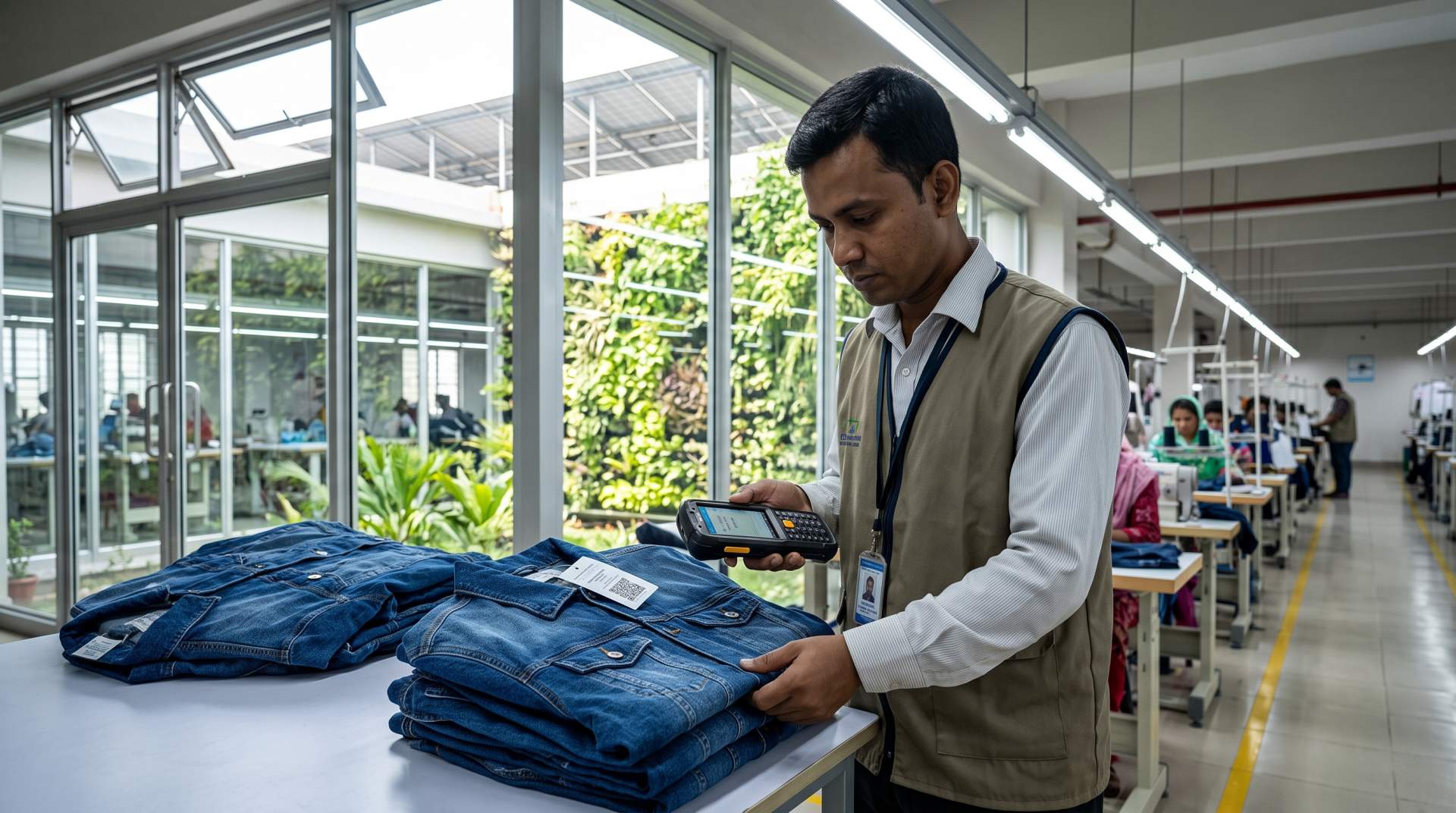
EU greenwashing ban, Walk onto the showroom floor of almost any major export garment group in Gazipur, Narayanganj, or Chattogram, and the first thing executives point to is a framed glass plaque from the U.S. Green Building Council. Over the past decade, Bangladeshi textile entrepreneurs have poured hundreds of millions of dollars into rainwater harvesting, solar rooftops, daylight-optimized sewing floors, and high-efficiency chillers. By mid-2026, Bangladesh had built 287 Leadership in Energy and Environmental Design (LEED) certified garment factories, more than any other country on Earth, including over half of the world’s top 100 highest-scoring green industrial buildings.
For years, those green buildings served as an all-purpose sustainability shield for international fashion retailers. A European high-street brand could source cotton shirts from a LEED Platinum factory in Dhaka, slap a green leaf icon or an "Eco-Friendly Collection" hang tag on the collar, and market the clothing to climate-conscious shoppers in Berlin, Paris, or Stockholm.
As of last Sunday, September 27, 2026, that marketing playbook is illegal across the European Union. Under the newly enforced EU greenwashing ban, formally known as Directive (EU) 2024/825 on Empowering Consumers for the Green Transition (ECGT), retailers selling into the 27-nation bloc can no longer use generic environmental phrases such as "green," "eco-friendly," "sustainable," or "conscious" unless the claim is backed by recognized, product-specific lifecycle proof. Nor can brands claim a garment is "carbon neutral" or "climate positive" simply because they bought carbon offsets.
Coming on the heels of a separate EU prohibition on destroying unsold clothes that took effect on July 19, 2026, the new rules mark a permanent shift for Bangladesh’s readymade garment (RMG) industry. Having a certified green factory wall is no longer enough; to keep winning European orders, Bangladeshi manufacturers must now prove the environmental footprint of every spool of yarn, dye bath, and kilowatt-hour of electricity inside the garment itself.
What the EU Greenwashing Ban Actually Outlaws
For much of 2025 and early 2026, confusion hung over Brussels’ environmental rulebook after European lawmakers paused negotiations on a separate proposal called the standalone Green Claims Directive. Many suppliers in Asia assumed the regulatory pressure had eased.
It had not. Unlike the paused proposal, Directive (EU) 2024/825 was already adopted into European law in February 2024. EU member states were required to transpose its rules into national legislation by March 27, 2026, with hard enforcement beginning on September 27, 2026, without a grace period. By amending the EU’s Unfair Commercial Practices Directive, the law puts strict prohibitions into the hands of national consumer protection authorities across Europe:
No vague green buzzwords: Terms like "eco-friendly," "green," "biodegradable," "nature’s friend," or "energy efficient" are banned on hang tags, packaging, and e-commerce product pages unless the seller can demonstrate officially recognized lifecycle excellence specific to that item.
No offset-based neutrality claims: Declaring a sweater or pair of jeans "carbon neutral" or "net zero" based on reforestation or carbon-credit purchases outside the product’s actual manufacturing chain is prohibited outright.
No self-invented sustainability badges: Retailers can no longer display their own internal "green leaf" logos or private sustainability trust marks. Any eco-label shown to European shoppers must be established by a public authority or verified under an independent third-party certification scheme meeting international standards such as ISO 17065.
No attributing partial virtues to the whole garment: If a jacket contains 20 percent recycled polyester and 80 percent virgin synthetic fiber, a brand cannot advertise the entire jacket as "made with recycled materials" without stating the exact verified percentage.
While the legal penalties target the retailer placing the product on the European market, the burden of proof travels straight down the supply chain to Dhaka. When an EU consumer watchdog audits a fashion brand’s product listing in Madrid or Amsterdam, the brand’s compliance team demands the underlying certificates, chemical logs, and fiber-origin records from its Bangladeshi factory before a shipment ever leaves Chattogram Port.
The July Unsold-Clothes Ban and the End of Bulk Guessing
The September 27 anti-greenwashing rules are only one half of Europe’s 2026 regulatory pincer. Two months earlier, on July 19, 2026, a second major provision kicked in under Regulation (EU) 2024/1781, the Ecodesign for Sustainable Products Regulation (ESPR): a direct ban prohibiting large companies from destroying unsold clothing, accessories, and footwear across the EU.
According to assessments by the European Environment Agency (EEA), between 4 percent and 9 percent of all textile products placed on the European market were previously destroyed before ever being worn, amounting to roughly 264,000 to 594,000 tonnes of brand-new garments incinerated, landfilled, or shredded every year. Under Article 25 of the ESPR, both dead warehouse stock and e-commerce customer returns are covered by the destruction ban, and even shredding brand-new unsold garments for low-grade fiber recycling is classified as prohibited destruction rather than reuse.
EU Regulatory MilestoneEffective DateCore Requirement for Apparel & FootwearDirect Impact on Bangladeshi SuppliersESPR Annual Waste Disclosure (Article 24)In force since July 19, 2025 (Standardized format March 2, 2027)Large EU companies must publicly report the number and weight of discarded unsold goods each year.Buyers tighten quality control to prevent defective batches that cannot be sold.ESPR Unsold Textile Destruction Ban (Article 25)July 19, 2026 (Large firms); July 19, 2030 (Medium firms)Prohibits incinerating, landfilling, or shredding unsold and returned clothes and footwear.Shifts buyer orders from huge speculative bulk runs to smaller, faster, reorder-driven batches.Empowering Consumers Directive, EU 2024/825September 27, 2026Bans generic green claims, offset-based "carbon neutral" tags, and unverified eco-labels.Requires batch-level fiber certificates and verified factory energy/water data per order.ESPR Digital Product Passport (DPP) for TextilesDelegated acts in preparation (Rollout expected 2027–2028)Mandatory scannable digital record tracking material origin, repairability, and lifecycle carbon footprint.Forces full digital chain-of-custody integration across spinners, dyers, and garment makers.Projected EU Carbon Tax / Supply Chain TariffsPost-2030 horizonIndustry studies warn apparel exports could face ~5% EU carbon-linked tariff pressure if emissions remain high.Penalizes garments manufactured using coal-heavy grid power or fossil-fired boilers.
For Bangladesh, the business model implications are immediate. Historically, Bangladesh’s competitive advantage has been high-volume, long-lead-time production of basic knitwear, denim, and woven trousers. European fast-fashion chains could order 200,000 units of a basic polo shirt six months in advance because unit prices in Dhaka were low enough that burning or discarding 8 percent of unsold seasonal stock in Europe was cheaper than managing lean inventory.
Now that destroying overstock is illegal for large European retailers, buyers are becoming far more cautious about over-ordering. Instead of placing massive seasonal commitments, European merchandisers are splitting orders into smaller initial test runs and demanding rapid restocking within weeks, a shift that favors suppliers with local fabric mills, automated inventory systems, and fast port turnaround times.
Why a Green Building Does Not Automatically Make a Green Shirt
The timing of Europe’s regulatory tightening is particularly sensitive for Dhaka. The European Union remains Bangladesh’s single largest export destination, absorbing roughly half of the country’s apparel shipments. During the first half of 2026 (January to June), Bangladesh’s garment exports to the EU fell 16.43 percent year-on-year to €8.64 billion, weighed down by European consumer caution and domestic energy bottlenecks.
Recent trade figures show tentative signs of a turnaround. According to Export Promotion Bureau (EPB) statistics released on October 1, Bangladesh’s total merchandise exports rose 8.54 percent year-on-year in September 2026 to $3.93 billion, bringing July–September first-quarter FY2026–27 earnings to $13.09 billion, driven by an 8.56 percent rebound in RMG shipments to $3.08 billion. Yet exporters acknowledge that sustaining that momentum in Europe requires closing a widening gap between building-level credentials and product-level proof.
Why doesn't a LEED Platinum certificate satisfy the EU greenwashing ban? Because LEED evaluates the physical architecture and site efficiency of the sewing or washing plant, such as how much electricity its LED lighting saves compared with a baseline building, or how well its rainwater tank flushes toilets.
Product-level lifecycle rules look at an entirely different equation:
Scope 3 Raw Material Origins: Up to 70 percent of a garment’s lifecycle environmental impact occurs upstream, in cotton farming, synthetic polymer extrusion, yarn spinning, and wet dyeing, long before the fabric reaches a sewing line in Savar. Because Bangladesh imports the vast majority of its raw cotton and a large share of its woven fabrics from China and India, a Bangladeshi sewing factory cannot substantiate a product’s environmental footprint unless its upstream textile mills provide cryptographic or third-party-audited transaction certificates for every bale of cotton or batch of recycled polyester.
The Grid Carbon Problem: Even when yarn spinning and fabric dyeing take place inside Bangladesh, the carbon footprint of each kilogram of fabric depends on the fuel burned to generate steam and electricity. As BANGLADESHIST recently detailed in our analysis of how Bangladesh coal power overtook natural gas generation for the first time this summer, soaring $24-per-MMBtu spot liquefied natural gas (LNG) prices forced national grid operators to lean heavily on coal-fired power stations in 2026. Under European lifecycle accounting, a garment sewn in a LEED-certified factory that draws electricity from an increasingly coal-heavy national grid, or relies on diesel backup generators during gas rationing, carries a higher Scope 2 carbon footprint than a garment produced using verified renewable electricity.
The Missing Green Price Premium: Despite building 287 LEED-certified factories, Bangladeshi manufacturers have long complained that international buyers treat green building certification as a baseline ticket for entry rather than paying higher prices per piece. Now, complying with the European Commission’s sustainable consumption rules and preparing for mandatory ESPR Digital Product Passports requires factories to pay for third-party chemical testing, batch-by-batch certification fees, and enterprise traceability software, all while unit prices remain under pressure.
The Digital Traceability Bottleneck for Mid-Sized Factories
For Bangladesh’s largest vertically integrated conglomerates, companies that own their own spinning mills, dyeing units, effluent treatment plants, and rooftop solar arrays, adapting to Europe’s product-level verification regime is an expensive but manageable engineering project. Several top-tier exporters in Dhaka and Narayanganj have already begun onboarding fiber-to-retail traceability platforms such as TextileGenesis, deploying rooftop solar agreements, and logging batch-level water and energy consumption to satisfy European audits.
The real vulnerability lies in the middle and lower tiers of Bangladesh’s export pyramid. Out of roughly 3,500 active export-oriented garment factories in the country, thousands are small and medium-sized enterprises (SMEs) that operate strictly as cut-and-make (CM) contractors. They do not own spinning mills, cannot afford dedicated sustainability compliance teams, and often track floor production using paper clipboards or basic spreadsheets.
Digitizing those mid-sized factories to feed data into European Digital Product Passports requires upgrading enterprise software, industrial sensors, and mobile data terminals across industrial zones outside central Dhaka. That digital upgrade faces its own local headwinds: as we explored in our report on how the global AI memory crunch is colliding with Bangladesh’s 2G shutdown plan, surging global DRAM and storage prices have pushed up the cost of entry-level computing and mobile hardware in late 2026, while industrial zones from Sirajganj to rural upazilas still grapple with uneven utility and telecom infrastructure.
If smaller Bangladeshi subcontractors cannot produce verifiable digital audit trails for their fabric lots and energy use, European brands worried about fines under Directive (EU) 2024/825 have two choices: strip all sustainability claims off their budget clothing lines, or consolidate their sourcing among a shrinking circle of giant, digitally connected megafactories in Bangladesh, Vietnam, and Turkey.
What Dhaka and the Apparel Sector Must Do Next
The enforcement of the EU greenwashing ban on September 27 is not the final chapter of Brussels’ green trade agenda; it is the opening act. Between 2027 and 2030, the European Union will phase in mandatory Digital Product Passports for textiles under the ESPR, require large companies to use standardized reporting for unsold inventory starting March 2, 2027, and extend the unsold-goods destruction ban to medium-sized European businesses on July 19, 2030. Beyond 2030, industry trade studies warn that Bangladeshi apparel exports to the EU could face carbon-linked border taxes equivalent to roughly 5 percent if supply-chain emissions are not measurably reduced.
At the same time, Bangladesh is preparing to graduate from Least Developed Country (LDC) status later this decade, a transition that will eventually test the duty-free access Bangladeshi garments currently enjoy under the EU’s Everything But Arms (EBA) scheme unless the country meets the strict environmental and labor conventions required for Generalized Scheme of Preferences Plus (GSP+) status.
For policymakers and industry leaders at the Bangladesh Garment Manufacturers and Exporters Association (BGMEA) and the Bangladesh Knitwear Manufacturers and Exporters Association (BKMEA), three practical steps can help bridge the gap between green buildings and verified garments:
Shift policy incentives from building plaques to digital traceability: Just as Bangladesh Bank and the National Board of Revenue (NBR) previously offered green refinancing schemes and tax breaks for LEED factory construction, low-cost financing and duty exemptions should now target digital chain-of-custody systems, automated energy meters, and accredited local laboratory testing so SME factories do not get priced out of compliance.
Unlock corporate renewable power purchasing: A factory cannot lower the lifecycle carbon footprint of its dyed fabric if it is forced to rely entirely on fossil-heavy grid electricity or captive gas boilers. Accelerating grid-tied industrial rooftop solar, building on the government’s recent push to expand rooftop solar across public and industrial rooftops, and allowing garment exporters to sign direct corporate power purchase agreements (PPAs) with utility-scale solar parks will give factories the verified renewable energy certificates European auditors require.
Standardize national supplier data: Rather than forcing every mid-sized factory in Gazipur to navigate twenty different proprietary software portals for twenty different European buyers, BGMEA and the ICT Division can establish a common, interoperable national compliance data standard aligned with the EU’s upcoming Digital Product Passport specifications.
Bangladesh’s garment sector proved over the past decade that it could transform its physical factories into the greenest industrial buildings in the world. Now that Europe has outlawed unverified green marketing at the checkout counter, the next test is whether Dhaka’s exporters can turn those green walls into transparent, verifiable data attached to every stitch they ship abroad.

Comments
0