


Earlier this week, the Bangladesh Telecommunication Regulatory Commission (BTRC) decided to seek government approval for a hard deadline: shutting down the country’s 2G mobile networks by December 2029. On paper, the goal is straightforward. Phasing out legacy second-generation networks frees up scarce radio spectrum for 4G and 5G services and nudges millions of remaining feature-phone users into the mobile internet economy.
Yet the regulator’s timeline has run straight into a supply-chain bottleneck originating thousands of kilometers away in the semiconductor fabs of South Korea, Taiwan, and the United States.
In September, Rehan Asif Asad, the prime minister’s adviser on posts, telecommunications, and ICT, outlined a government ambition to bring locally assembled 4G smartphones to Bangladeshi consumers for less than Tk 4,000. Within weeks, that target price had to be revised upward to Tk 5,000. The culprit was not domestic inflation or a sudden change in import tariffs. Instead, local handset assemblers are being hit by a sharp global surge in the cost of working memory (DRAM) and flash storage (ROM/NAND)—a price spike driven by the insatiable appetite of artificial intelligence data centers.
For years, technology policy in developing economies rested on a reliable deflationary rule: computing components get cheaper over time, making entry-level smartphones progressively more affordable. In 2026, the economics of AI infrastructure have temporarily reversed that rule. Understanding why requires looking inside the cleanrooms of the world’s three largest memory chipmakers—and seeing how a wafer-allocation decision in Gyeonggi Province or Idaho ripples all the way to assembly lines in Gazipur and Narayanganj.
The Silicon Tug-of-War: HBM vs. Commodity Memory
Every smartphone, laptop, and server relies on two fundamental types of memory chips: Dynamic Random-Access Memory (DRAM), which handles active tasks, and NAND flash, which stores files, apps, and the operating system. Because memory manufacturing requires multi-billion-dollar fabrication plants, global supply is heavily concentrated among three companies: South Korea’s SK hynix and Samsung Electronics, and US-based Micron Technology.
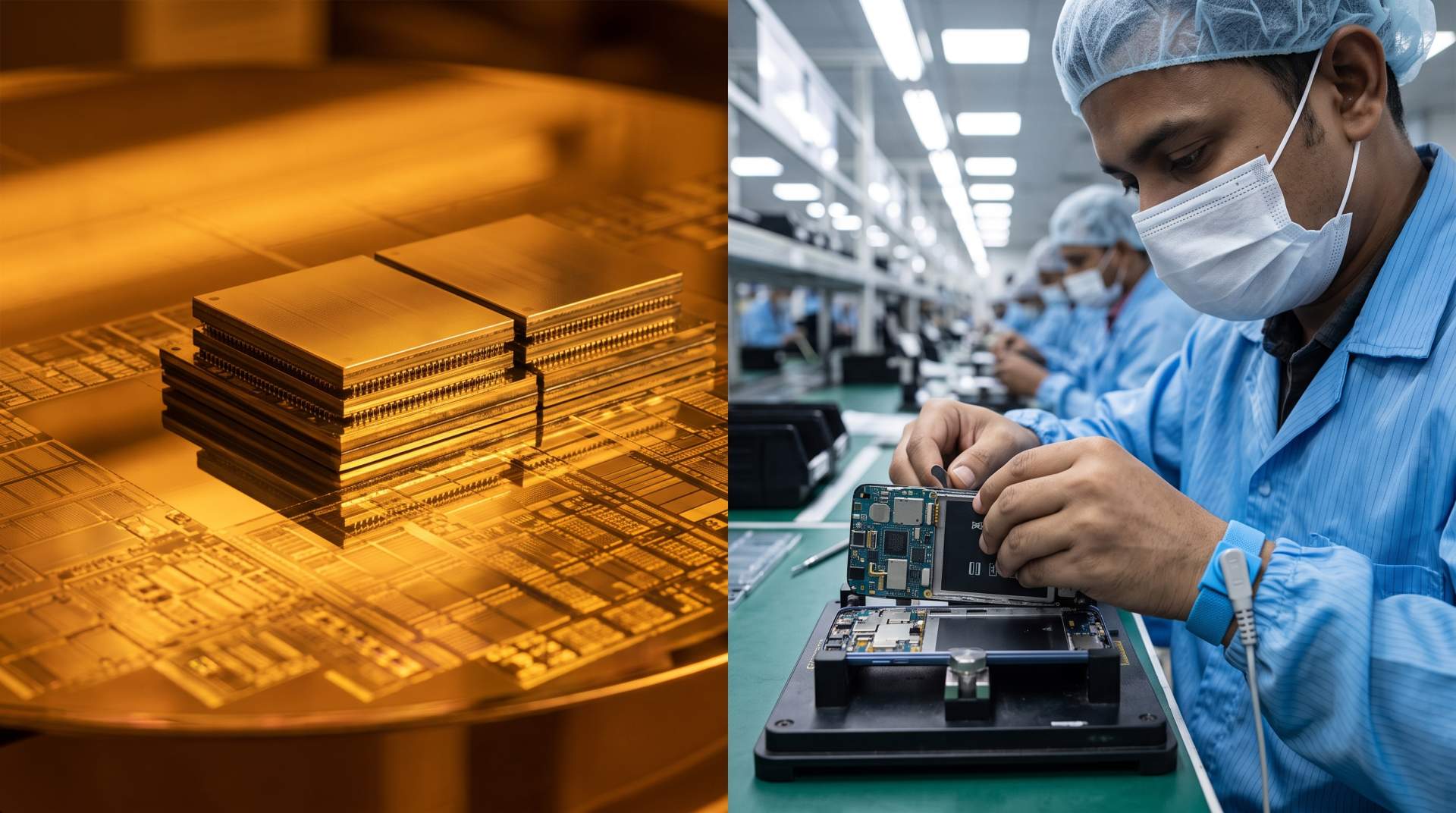
Over the past two years, the revenue math for those three manufacturers has changed dramatically. Tech giants building AI clusters around accelerators from NVIDIA and AMD do not buy standard server memory. They require High-Bandwidth Memory (HBM)—specifically HBM3E and the newer HBM4 generation, which entered mass production and qualification across late 2025 and 2026. HBM stacks multiple DRAM dies vertically like a skyscraper, connecting them with thousands of microscopic microscopic pathways known as through-silicon vias (TSVs) so massive AI models can be fed data without stalling.
For memory makers, HBM is exceptionally lucrative. In the third quarter of 2026, a 36-gigabyte HBM3E module commanded roughly $300 to $400 under long-term contracts and upward of $2,000 on the spot market. Samsung told investors during its first-quarter 2026 earnings call that its HBM4 volume for the year was already completely sold out, while Micron reported that revenue in its Cloud Memory Business Unit jumped more than fourfold year-on-year to $13.77 billion in its third fiscal quarter of 2026.
The catch for the rest of the electronics industry is physical. HBM dies are significantly larger than standard mobile DRAM dies, and stacking them yields a higher defect rate. Producing a single gigabyte of HBM consumes roughly three times the silicon wafer capacity required to produce a gigabyte of conventional DDR5 or mobile LPDDR memory.
Rather than risk an oversupply glut by building dozens of new commodity fabs overnight—new cleanrooms in Yongin, Cheongju, and Indiana will not come fully online until 2028 or 2029—SK hynix, Samsung, and Micron have systematically reallocated their existing wafer lines toward HBM and high-margin server DRAM. Industry tracker TrendForce estimates that HBM will absorb roughly 30 percent of total DRAM wafer input across the top three suppliers by 2027, with Samsung’s average monthly HBM wafer input projected to climb nearly 40 percent from 180,000 wafers in 2026 to 250,000 wafers in 2027.
How the Crunch Hits Consumer Devices
When wafer capacity is pulled away from conventional memory, the supply of standard RAM and storage for phones and personal computers tightens—even if consumer gadget demand is flat.
According to data from semiconductor research firm TrendForce, conventional DRAM contract prices surged between 93 percent and 98 percent quarter-on-quarter in the first quarter of 2026 alone, followed by further double-digit increases across both DRAM and NAND flash in the second and third quarters. Even older, legacy memory nodes used in ultra-budget electronics have seen steep contract hikes because factories are retiring older production lines to make room for advanced nodes.
Technology advisory firm Gartner estimates that combined prices for DRAM and solid-state storage will rise 130 percent by the end of 2026 compared with 2025 levels. As a direct result, Gartner forecasts that average global PC prices will climb 17 percent and smartphone prices will rise 13 percent this year, pushing global smartphone shipments down by an estimated 8.4 percent and PC shipments down by 10.4 percent.
In a $1,000 flagship phone, a $15 or $20 jump in memory and storage costs is an annoyance that a brand can either absorb in its margins or pass along to affluent buyers. In an entry-level smartphone designed to retail for $40 to $60 (roughly Tk 4,800 to Tk 7,200), memory and storage represent one of the largest single items on the bill of materials. When RAM and ROM prices double, it breaks the unit economics of the budget handset.
Inside Bangladesh’s Handset Squeeze
That global bill-of-materials shock is now visible in Bangladesh’s industrial production numbers. Over the past seven years, Bangladesh built a sizable domestic handset assembly ecosystem through differential tax policies that made importing finished phones expensive while keeping duties on knocked-down component kits low. At its peak, local assembly plants met more than 90 percent of official domestic handset demand.
However, local plants remain assembly and testing operations rather than deep component manufacturers. Every processor, display panel, battery cell, and memory module must be imported, leaving Bangladeshi factories completely exposed to global semiconductor pricing and foreign-exchange costs.
According to BTRC production statistics reported in late September 2026, local smartphone output fell 9.9 percent year-on-year during the first eight months of the year, dropping to 53.76 lakh units between January and August 2026 from 59.66 lakh units in the same period of 2025.
The memory price surge has arrived on top of two domestic challenges that were already hurting factory utilization:
The Grey Market Dominance: Industry executives estimate that unofficial "grey market" phones—handsets brought into the country through luggage channels or cross-border smuggling without paying import duties—currently account for more than 60 percent of smartphone sales in Bangladesh, while grey-market traders claim that 70 to 75 percent of local buyers rely on imported second-hand devices for affordability.
Delayed Enforcement of NEIR: To curb illegal and cloned handsets, the BTRC banned the import of used phones and announced that the National Equipment Identity Register (NEIR)—which disconnects unapproved devices from mobile networks—will become mandatory on December 16, 2026. Yet repeated delays in full NEIR enforcement over recent years have left official manufacturers competing against tax-free grey imports just as their own component costs climb.
Recognizing the pressure on local plants, the government used the national budget for the 2026–27 fiscal year to slash the advance income tax (AIT) on imports of 22 raw materials used in mobile phone manufacturing down to 1 percent, while extending duty exemptions and conditional VAT relief on handset components until June 2030.
Still, fiscal relief at the port of entry can only offset a fraction of a 100-percent-plus surge in global memory chip contract prices. When domestic manufacturers warned officials in September that sub-Tk 4,000 smartphones were unviable under current component pricing, the government was forced to adjust its public benchmark to Tk 5,000. Even at Tk 5,000, assembling a usable 4G smartphone—one with enough RAM and storage to run Android Go, mobile banking apps, and WhatsApp without freezing—requires razor-thin margins.
The 2029 2G Cutoff and the Connectivity Paradox
This hardware bottleneck matters for everyone in Bangladesh because of how the country connects to the internet. According to Bangladesh Bureau of Statistics (BBS) survey data published in September 2026, 98.2 percent of households in Bangladesh rely exclusively on mobile phones for telecommunications, while fixed-line telephone penetration stands at just 0.7 percent and household computer access has barely grown. For the vast majority of citizens, the mobile handset is the only gateway to digital services.
Yet roughly a quarter of the population has not yet crossed the bridge to smartphones; national smartphone penetration stood at 75.1 percent in the latest 2026 figures, up only fractionally from 74.8 percent a year earlier. Millions of rural earners, agricultural workers, and low-income urban residents continue to rely on 2G feature phones ("button phones") for voice calls and basic SMS.
By seeking cabinet approval to switch off 2G networks by December 2029, the BTRC is trying to solve a genuine infrastructure problem. Mobile operators—Grameenphone, Robi Axiata, Banglalink, and state-owned Teletalk—currently have to maintain legacy 2G equipment alongside 4G networks while preparing for future spectrum renewals. Refarming 900 MHz and 1800 MHz spectrum away from 2G allows operators to improve 4G indoor penetration and data speeds without buying entirely new frequency bands.
However, telecom analysts and industry officials point out that shutting down 2G only works if the remaining 2G users have an affordable path onto 4G Voice over LTE (VoLTE) networks. As one telecom policy observer told The Daily Star following the BTRC’s October 2 decision, sunsetting 2G should be the outcome of digital inclusion rather than a precondition for it, requiring affordable 4G/VoLTE devices, reliable nationwide voice coverage, and migration incentives.
Coverage itself remains uneven. A BTRC quality-of-service assessment published in September 2026 revealed notable gaps between operator-reported metrics and regulator field tests, including six upazilas—several in the hilly district of Bandarban—where measurements recorded "No Service" on both 2G and 4G networks for certain operators.
Meanwhile, if a rural household’s 2G phone goes dark in 2029, that family has two options: buy a 4G-enabled VoLTE keypad feature phone, or upgrade to an entry-level smartphone. Both options require more advanced baseband modems and larger memory footprints than legacy 2G handsets—the exact semiconductor components currently facing global price inflation.
What Happens Next
Between now and the end of 2026, two immediate tests will determine whether Bangladesh’s handset market stabilizes or tightens further.
The first is the December 16, 2026 deadline for mandatory NEIR activation. If the BTRC follows through on blocking unauthorized new imports while keeping existing active handsets connected, official local assemblers could regain market share from the grey market, improving factory utilization and giving them the volume needed to absorb narrower per-unit margins. Conversely, if NEIR enforcement is cut off from a realistic supply of cheap, legal entry-level devices, cutting off second-hand imports will simply raise the floor price of getting online for low-income buyers.
The second test lies outside Dhaka’s control. Memory industry analysts do not expect the global DRAM and NAND supply crunch to ease quickly; with major new HBM and DRAM fabrication plants in South Korea and the United States scheduled to open cleanrooms mainly between 2028 and 2029, memory prices are projected to remain elevated through at least 2027.
For policymakers in Dhaka, the lesson of late 2026 is that national digital roadmaps cannot be drawn in isolation from the physical supply chains of global computing. As long as Silicon Valley’s AI buildout continues to bid away the world’s silicon wafers, the cost of bringing the next 40 million Bangladeshis onto 4G will be decided as much in the boardrooms of Seoul and Boise as in the regulatory offices of Agargaon.



Comments
0