


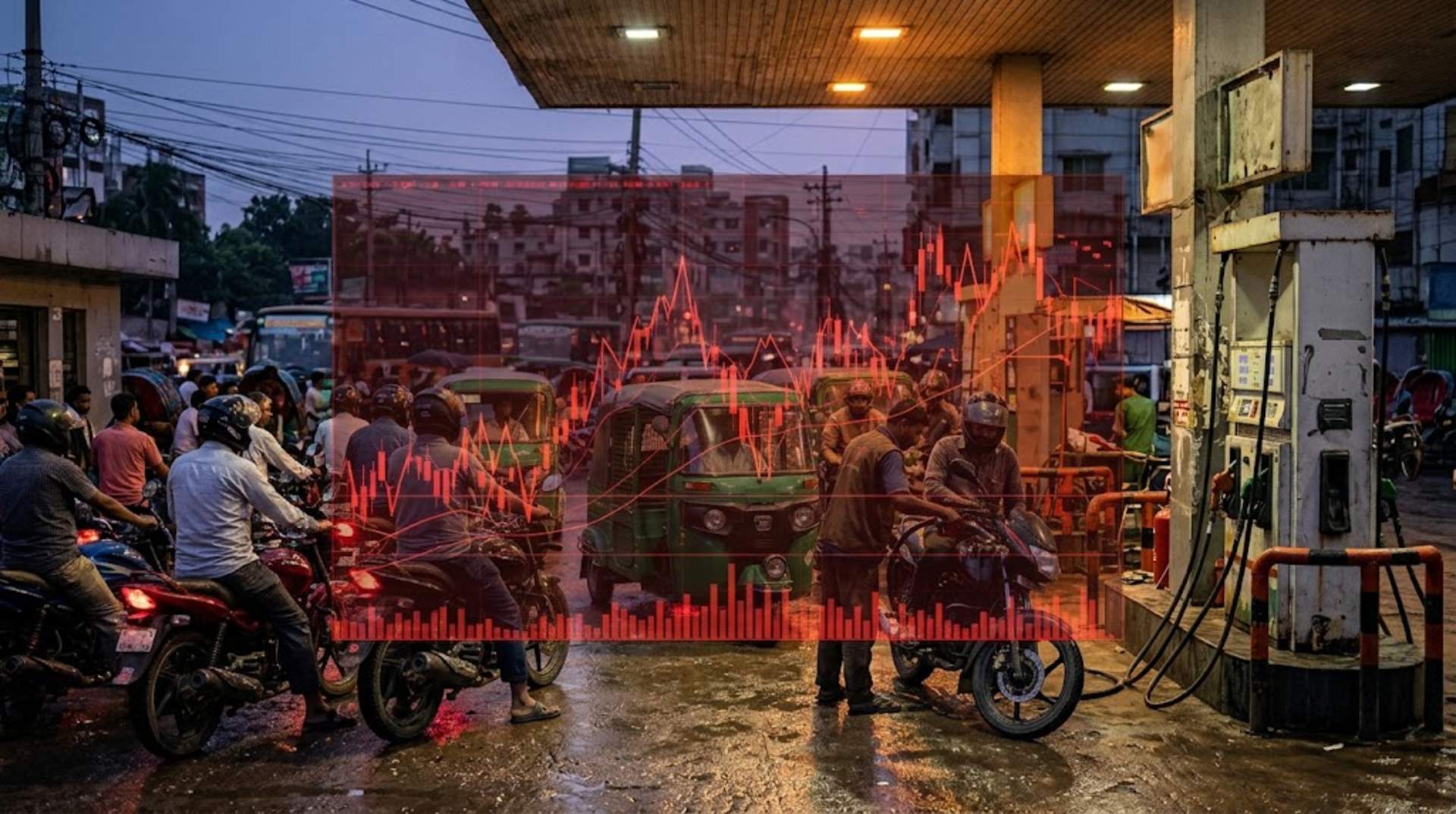
Brent crude settled at $116.72 a barrel on Friday, its highest close since 29 April, after Houthi attacks in Saudi Arabia revived fears of a wider hit to Gulf energy supplies. For Bangladesh, which buys much of its fuel from the Gulf and relies on Gulf-based workers for a large share of its remittances, the timing is awkward. Fuel prices went up barely a month ago, remittance growth has cooled, and inflation is edging higher.
This is not a picture of collapse. Foreign-exchange reserves are solid, and remittances are still well above last year's level for the fiscal year so far. But the country's cushions are being tested from two directions at once.
What happened in the oil market
Reuters reported that Brent rose $3.55, or 3.14%, on Friday and finished the week about 6% higher. US crude closed at $103.27. Traders pointed to the Houthi attacks in Saudi Arabia and an oil spill reported by UAE authorities. Al Jazeera reported that vessels in and around the Strait of Hormuz continue to come under attack, and that the odds of renewed US–Iran fighting have risen.
There is a wrinkle. Some analysts say the oil actually moving through Hormuz has recovered, which suggests the price reflects the risk of a stoppage rather than a shortage today. That offers limited comfort to an importer. A risk premium can fade quickly, but it can also harden if the fighting spreads.
Fuel prices: one hike done, pressure remains
On 21 September the government raised the retail prices of diesel, octane, petrol and kerosene by Tk 20 a litre. Diesel went from Tk 115 to Tk 135, a rise of 17.4%, and octane from Tk 145 to Tk 165.
The Energy and Mineral Resources Division said international petroleum and freight prices had more than doubled since March. The state-run Bangladesh Petroleum Corporation lost about Tk 228.76 billion (roughly $1.9 billion) between March and August, the ministry said, and the new prices should trim annual losses by around Tk 100 billion. It was the second increase since the BNP government took office in February. The first came in April.
Passengers have already reported knock-on effects. The Daily Sun quoted travellers who said some bus operators were charging up to Tk 50 more on routes out of Dhaka, and up to Tk 100 more to Chattogram, before any official fare change. Those are passenger accounts, not confirmed fare data.
Official inflation shows only the start. Point-to-point inflation rose to 8.34% in September from 8.26% in August, with food inflation at 7.22%, up from 7.02%, according to Bangladesh Bureau of Statistics data reported by UNB.
Analysis: because the price rise took effect on 21 September, most of its impact on transport and food costs will probably show up in the October and November figures.
Remittances: a softer month inside a strong quarter
Bangladesh received about $2.77 billion in remittances in September, the lowest monthly total in 11 months, according to Bangladesh Bank data. That was about 3% above a year earlier, but well below August's $2.96 billion, which had been 22% higher year on year. Across July to September, inflows were about $8.6 billion, up roughly 13%.
Bangladesh Bank spokesperson Arief Hossain Khan told The Daily Star that the cost of living in the Gulf region has risen sharply because of the conflict, leaving workers with less to send home. Fahmida Khatun of the Centre for Policy Dialogue said the crisis is unlikely to end soon and urged the government to diversify the countries it sends workers to, including Malaysia and Singapore.
Early October numbers look better. Central bank data show $388 million arrived between 1 and 4 October, against $141 million in the same days last year, and $8.98 billion for 1 July to 4 October, up 16.2%. But four days is a thin sample, and October 2025 was itself a weak month at $2.56 billion. It is too early to call a rebound.
The longer-term worry is people, not just money. About 9.7 lakh Bangladeshis went abroad for work in 2025–26, down 5% and a five-year low, according to the Bureau of Manpower, Employment and Training. Departures have now fallen two years in a row, which limits how fast remittances can grow.
Reserves: the buffer is holding
Gross reserves stood at $36.21 billion on 11 October. Under the IMF's stricter BPM6 method, they were $31.40 billion, Bangladesh Post reported, citing central bank data.
Bangladesh Bank has also told commercial banks it will no longer help them collect dollars for import bills and other obligations, so they must arrange the money themselves, The Daily Star reported.
Analysis: that suggests the central bank wants to conserve reserves. It could also push more pressure onto banks and importers if dollar demand rises along with oil prices.
What to watch next
The Gulf matters to Bangladesh on both sides of the ledger. A Business Standard analysis put six Gulf countries' share of Bangladesh's remittances at 55.4% in 2024–25. That means a prolonged escalation can raise the oil bill and cut incomes abroad at the same time.
Three things will show whether the strain is deepening: Bangladesh Bank's October remittance figure, due in early November; the October inflation reading; and whether oil stays near current levels, which could revive the pressure on fuel prices.
For now, the data show strain, not breakdown. The real test is whether the Gulf stays this volatile long enough for a higher oil bill and slower remittances to land together.

Comments
0