


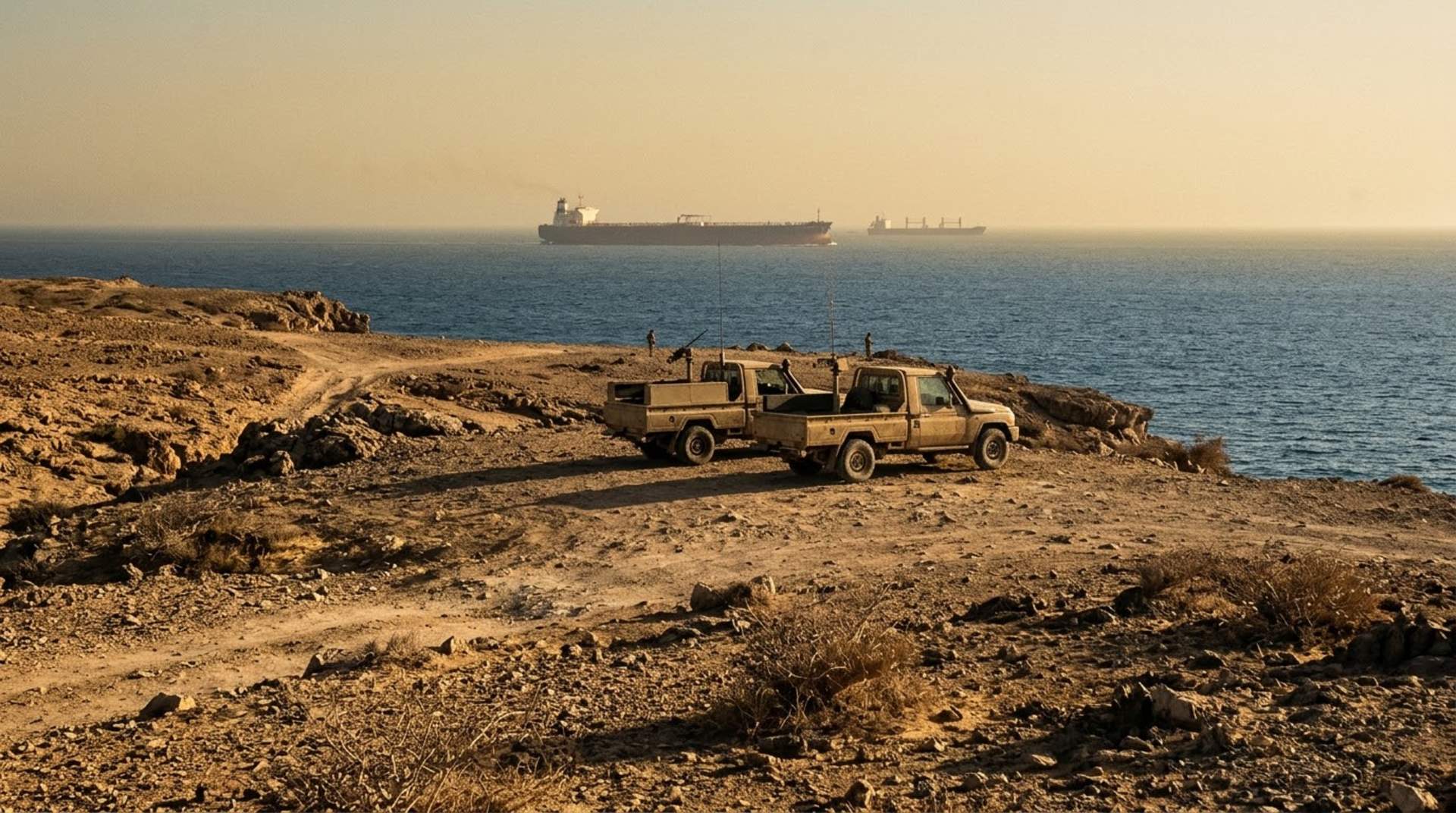
Saudi-backed Yemeni government troops have reclaimed effective control of the Bab el-Mandeb Strait after launching a rapid coastal offensive on Monday that drove Iran-aligned Houthi fighters out of key positions along the Red Sea shoreline.
Backed by roughly 100 fighter jets from the Saudi-led coalition, pro-government units including the Southern Giants Brigades pushed north along Yemen's western coast, retaking the strategic Dhubab district at the narrowest point of the waterway before advancing to the port city of Mocha. Yemen's Defense Ministry reported late Monday that Mocha had fallen and that Houthi units were retreating east into the interior highlands.
Yemen's Information Minister Moammar al-Eryani told Reuters that government forces had captured the Dhubab airstrip just inland from the coast, cutting off remaining Houthi pockets near the water. However, military sources cautioned that combat had not fully ended, noting that clashes continued around a nearby coastal military base.
Houthi spokespeople rejected the government's battlefield reports as "completely untrue" and threatened to strike any aircraft operating inside Saudi airspace. Even with that dispute over exact frontline boundaries, Monday's counteroffensive marks the biggest territorial reversal on Yemen's Red Sea coast since Houthi forces overran the area in mid-September.
Why the Bab el-Mandeb Strait Is a Global Oil Lifeline
Connecting the Red Sea to the Gulf of Aden and the Indian Ocean, the 32-kilometer-wide channel between Yemen and Djibouti normally carries nearly 10 percent of global seaborne trade and 5 to 7 percent of the world's oil shipments. In 2026, however, its value to global energy markets increased sharply.
With the Strait of Hormuz closed amid the eight-month-old war involving Iran and the United States, Persian Gulf producers have lost their main eastern maritime exit. That bottleneck, which already triggered an Asian LNG price spike and forced power grids back toward coal, left Saudi Arabia heavily dependent on its East-West pipeline network to pump crude to terminals on the Red Sea.
Between March and mid-July 2026, Saudi seaborne crude oil exports passing through the Bab el-Mandeb Strait jumped eightfold compared with pre-war levels. When four years of relative calm in Yemen collapsed in July and Houthi fighters seized Mocha, Dhubab, Perim Island, and the Hanish Islands around September 10, Riyadh faced the prospect of having both of its maritime oil corridors choked off at once.
Following their September coastal sweep, the Houthis declared a blockade targeting Saudi shipping and launched waves of ballistic missiles and drones against southern Saudi cities, including Jizan, Abha, and Khamis Mushait, sparking fires at oil and utility installations and pushing global crude prices above $100 a barrel.
Airpower on the Coast, Siege in the Highlands
The counteroffensive launched on Monday followed a Sunday directive from Rashad al-Alimi, chairman of Yemen's internationally recognized Presidential Leadership Council (PLC), ordering military units to move "from preparation to action." On the flat coastal plain stretching from Dhubab to Mocha, open terrain allowed Saudi coalition warplanes to strike Houthi vehicle columns and radar sites with little natural cover.
Pushing Houthi artillery and spotters off the shoreline makes it significantly harder for the group to target commercial tankers passing through the shipping channel at close range. That coastal relief matters not only for Gulf oil loaders, but also for Asia-to-Europe container lines and regional terminal operators, at a time when major ports are restructuring terminal concessions to speed up vessel turnaround.
Yet retaking the beach does not neutralize the Houthi arsenal. Perched in the rugged mountain ranges overlooking the coastal strip, Houthi forces still possess long-range anti-ship ballistic missiles, cruise missiles, and one-way attack drones capable of reaching both the Red Sea lanes and Saudi infrastructure.
Pressure Builds Around Taiz and Regional Defense Pacts
While government brigades celebrated gains along the water, Houthi fighters tightened their grip further inland. According to military sources cited by The Japan Times, recent advances have left Taiz, an inland city of more than 500,000 residents and a major government garrison, surrounded by Houthi forces. Long queues for cooking gas and motor fuel have already formed across besieged neighborhoods on the city's outskirts.
The escalating cross-border strikes have also activated new regional security alignments. Following a high-level meeting, Saudi Arabia, Turkey, and Pakistan issued a joint statement condemning Houthi drone and missile attempts aimed toward Mecca, Medina, and civilian economic facilities inside the kingdom. The three nations signed the Mecca Joint Defence Agreement in August 2026, a mutual defense pact stipulating that an armed attack against one member is treated as an attack on all three.
For energy traders and shipping insurers watching the Bab el-Mandeb Strait this week, the key test is whether Yemeni government forces can hold Mocha and clear the offshore islands of Perim and Hanish without getting bogged down in a mountain war around Taiz. Until ships can transit the Red Sea without drawing fire from the highlands, the world's most important backup oil corridor remains on a hair trigger.

Comments
0