


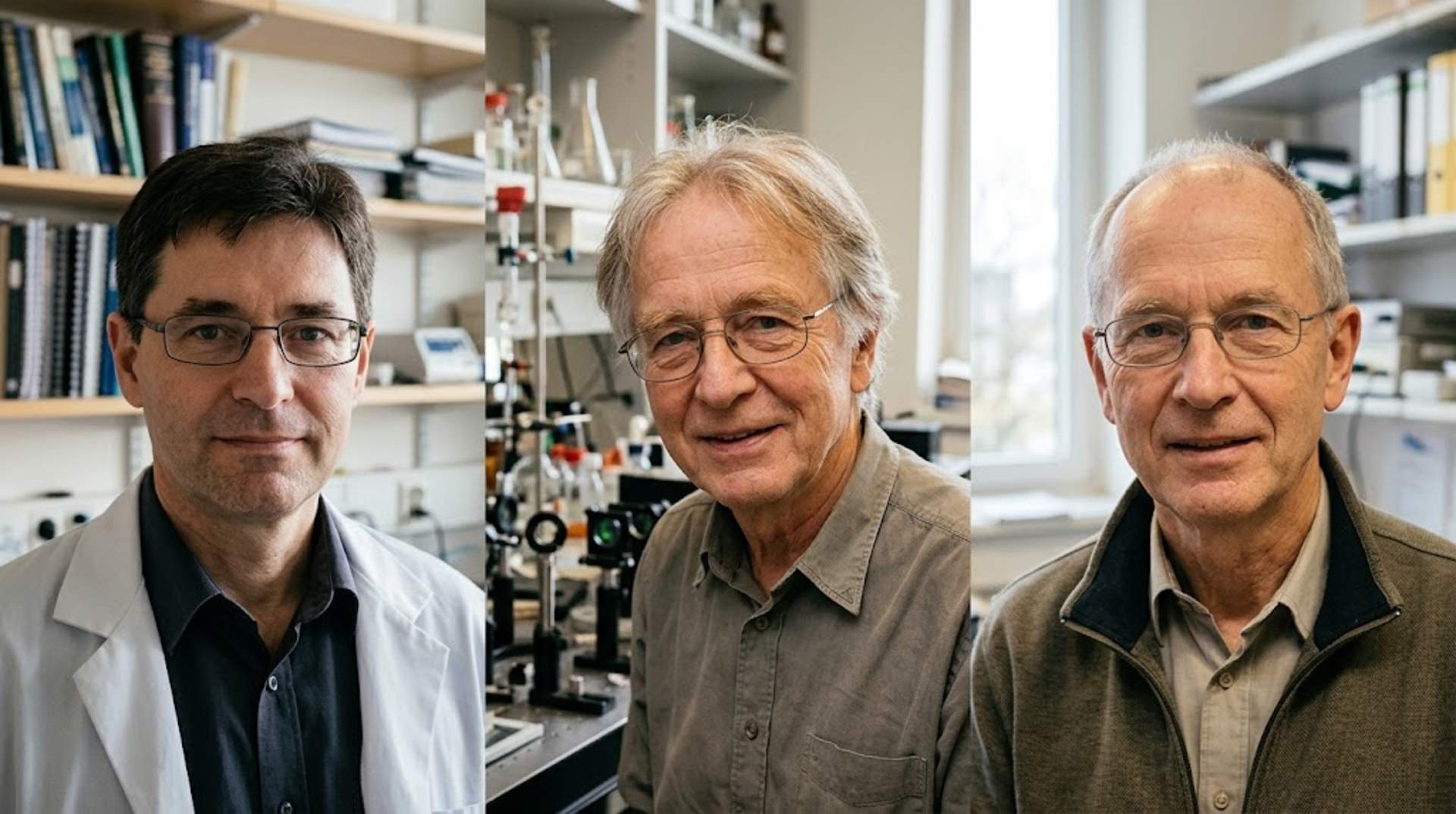
The 2026 Nobel Prize in Medicine has been awarded to American neuroscientist and psychiatrist Karl Deisseroth alongside German biophysicists Peter Hegemann and Georg Nagel for developing optogenetics, a technique that uses beams of light to switch individual nerve cells on and off inside the living brain.
Announced on Monday, October 5 by the Nobel Assembly at Sweden's Karolinska Institute in Stockholm, the official Nobel citation honors the trio "for their discoveries concerning light-gated ion channels and optogenetics." The three laureates will equally share the 12 million Swedish kronor ($1.2 million) prize purse.
For decades, neuroscientists struggled with a basic mechanical problem: the mammalian brain packs tens of billions of intertwined neurons that communicate through rapid electrical and chemical pulses. Stimulating brain tissue with metal electrodes was like trying to play a single piano key using a sledgehammer, because electricity activates every nearby cell at once. Drugs acted too slowly, taking minutes or hours to wash through the bloodstream while researchers needed to track thoughts, movements, and memories happening in milliseconds.
The solution that transformed brain science did not come from studying human tissue. Instead, it began with a basic question about how single-celled green pond algae swim toward sunlight.
How Pond Algae Gave Neuroscience a Light Switch
In the 1980s and 1990s, Peter Hegemann, then working at the Max Planck Institute for Biochemistry in Germany and now a professor at Humboldt University of Berlin, studied a microscopic green alga called Chlamydomonas reinhardtii. Each algal cell carries a tiny orange "eyespot" on its surface that senses light and guides the organism's movement so it can photosynthesize.
Using microscopic electrodes, Hegemann discovered that the alga reacted to light at astonishing speed. Within half a millisecond of illumination, an electrical current surged across the cell's outer membrane. That speed suggested that a single protein was doing two jobs at once: capturing light photons and opening a physical gate, known as an ion channel, to let charged particles flow into the cell.
To prove how the mechanism worked, Hegemann teamed up with Georg Nagel, a biophysicist then at the Max Planck Institute for Biophysics in Frankfurt and now a professor at the University of Wurzburg. In 2002 and 2003, Hegemann and Nagel isolated two algal genes and inserted them into frog eggs in the laboratory.
When the researchers shone a light on the modified eggs, the newly produced proteins snapped open, allowing charged ions to rush across the membrane and generate an electrical signal. They named these light-sensitive gatekeeper proteins channelrhodopsin-1 and channelrhodopsin-2. Crucially, they showed that transferring a single algal gene into an animal cell could make that cell respond to light.
Turning Algal Proteins Into Brain Controls
Across the Atlantic at Stanford University, Karl Deisseroth was searching for a better way to understand the biological roots of psychiatric disorders. Trained as both a clinical psychiatrist and a neuroscientist, Deisseroth saw firsthand how existing treatments for severe depression, schizophrenia, and anxiety often failed patients or caused heavy side effects because doctors did not know which specific neural circuits were misfiring.
In 2005, Deisseroth and his Stanford research team inserted the gene for channelrhodopsin-2 into rat nerve cells grown in a laboratory dish. By flashing pulses of blue light onto the dish, they triggered crisp, millisecond-accurate nerve signals on command. A year later, the technique was formally named optogenetics, combining optics and genetics.
Two years after his petri-dish breakthrough, Deisseroth's group showed that the method worked inside the intact brains of living mice. By delivering the algal gene to specific groups of neurons and threading a hair-thin optical fiber through a tiny opening in the skull, the team controlled the movement of a mouse's whiskers simply by flicking a blue light switch.
Since that demonstration, laboratories worldwide have adopted optogenetics as a standard discovery tool. By pairing light-activated switches with genetic targeting, scientists can silence or activate one exact type of neuron while leaving neighboring cells untouched. Researchers have used the method to map the exact brain circuits that form fear memories, regulate sleep, govern hunger, drive addiction, and control motor tremors in Parkinson's disease.
Why the 2026 Nobel Prize in Medicine Matters for Patients
While optogenetics remains primarily a laboratory research tool for mapping animal brains, its clinical footprint in human medicine is expanding rapidly. Because introducing foreign algal genes and optical fibers into the deep human brain carries surgical and immune hurdles, the earliest human trials have focused on an organ that is already built to let light in: the eye.
Speaking during Monday's announcement in Stockholm, Per Svenningsson, a professor of neurology at the Karolinska Institute, highlighted how clinical trials are already using optogenetics to treat blindness caused by retinitis pigmentosa, a degenerative genetic disease that destroys the eye's natural light-sensing rods and cones. By injecting channelrhodopsin genes into the healthy retinal nerve cells that remain intact behind the damaged photoreceptors, doctors have enabled formerly blind patients wearing specialized light-amplifying goggles to perceive shapes and objects again.
Parallel medical engineering teams in Germany, building on the foundational work of Hegemann and Nagel, are also developing optogenetic cochlear implants. Traditional cochlear implants use electrical currents that spread out in the inner ear, making it hard for users to follow conversations in noisy rooms or appreciate music. Optical implants use focused micro-lights to stimulate narrow bands of auditory nerve fibers, offering much sharper sound resolution.
Beyond those direct therapies, the 2026 Nobel Prize in Medicine serves as a timely defense of basic, curiosity-driven science. Neither Hegemann nor Nagel set out to cure blindness or map depression when they began probing how pond algae swim toward the sun. Yet without their persistence in decoding a humble microorganism, neuroscientists would still be watching the living brain in the dark.




Comments
0