BangladeshistBangladeshistBangladeshist
HomeWorldSportsPoliticsEntertainment
About UsContact UsPrivacy Policy
Terms of ConditionsFAQ
FacebookInstagramYouTubeTwitterTikTok
BangladeshistBangladeshist

© 2026 Bangladeshist. All rights reserved.

  1. Home
  2. Science
  3. Orionid Meteor Shower Peaks Over Bangladesh, Offer…
Science

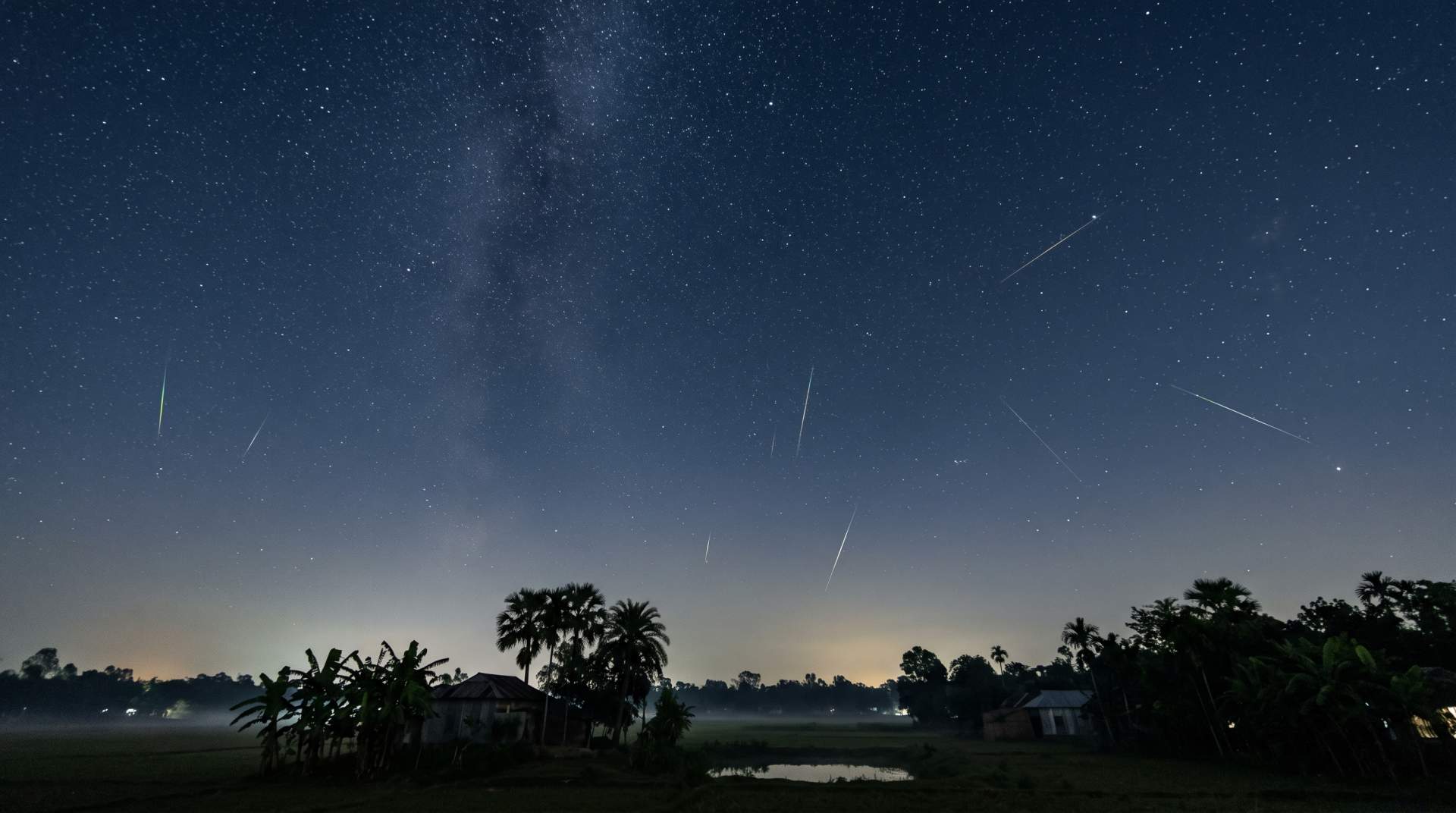
Orionid Meteor Shower Peaks Over Bangladesh, Offering Up to 20 Shooting Stars an Hour

Plabonn
Plabonn
Thursday, October 22, 2026Source:NASA, American Meteor Society, Observer Online5 min read
Orionid Meteor Shower Peaks Over Bangladesh, Offering Up to 20 Shooting Stars an Hour
The Orionid meteor shower peaks around October 21–22, offering a chance to see up to 20 meteors an hour under ideal conditions, though moonlight may obscure fainter shooting stars.
share:

The Orionid meteor shower is reaching its peak around October 21–22, giving skywatchers across Bangladesh an opportunity to spot shooting stars created by debris from Halley’s Comet.

The annual celestial display can produce around 10 to 20 meteors per hour under ideal viewing conditions, according to NASA and the American Meteor Society. However, the actual number visible to observers will depend on cloud cover, light pollution and the brightness of the night sky.

This year, a waxing gibbous Moon illuminated by roughly 74 percent of its surface is expected to make observations more difficult during the earlier part of the night. Moonlight can wash out fainter meteors, meaning observers may see fewer shooting stars than the theoretical peak rate suggests.

Best time to watch the meteor shower

The most promising viewing period is from midnight until just before dawn, particularly after the Moon sets and darker skies return. Observers should choose a location with a broad, unobstructed view of the sky and as little artificial lighting as possible.

People in rural areas or places away from brightly lit streets and buildings may have a better chance of spotting meteors than those observing from densely illuminated urban areas. Even from cities, brighter meteors may still be visible when skies are clear.

No telescope, binoculars or other special equipment is required. The shower can be observed with the naked eye, allowing viewers to take in a wide section of the sky rather than concentrating on a small area.

For better results, observers should give their eyes around 20 to 30 minutes to adjust to the darkness and avoid looking at bright phone screens. Meteors can appear across the sky, even though the Orionids seem to originate from a point near the constellation Orion.

What causes the Orionids?

The Orionids occur when Earth passes through a stream of dust and small particles left behind by Halley’s Comet. As these particles enter Earth’s atmosphere at high speed, they heat up and produce the brief streaks of light commonly called shooting stars.

Halley’s Comet takes approximately 76 years to complete an orbit around the Sun. Although the comet itself does not need to pass close to Earth for the shower to occur, its trail of debris creates the Orionids every year.

The meteor shower is active from early October into November, so observers who miss the peak may still have opportunities to see Orionids over the coming nights, although activity generally declines after the maximum.

Clear weather remains essential for successful viewing. Clouds can block the display entirely, while haze and urban lighting can make fainter meteors difficult to detect.

For Bangladeshis hoping to catch the event, the best approach is to find a safe, dark viewing spot, allow time for their eyes to adapt and watch patiently during the late-night and pre-dawn hours.


Tags:#Orionid meteor shower#Bangladesh skywatching#shooting stars#October 2026#Halley’s Comet#astronomy
share:

Comments

0

Write your comment

Please keep comments respectful.

Loading comments…

Most Read

1

HSC Results 2026: When and How to Check Results in Bangladesh

Oct 29
2

Benin Thrash India 27–0 at U18 School Football World Cup

Oct 22
3

Toyota Solid-State EV Battery Enters Early Mass Production

Oct 10
4

NASA Delays Artemis Moon Landing to 2028 Over Starship Issues

Oct 8
5

E-Commerce Business Guide: How to Properly Set Up an Online Storefront

Jun 16

Popular Tags

#Bangladesh Economy#Barcelona#Inflation#Artificial Intelligence#UEFA Champions League#Bangladesh Bank#Energy Security#Real Madrid#Global Economy#Bayern Munich#Bangladesh#Public Health

Read More

All Stories in Read More →
Bangladesh Targets 4,000MW of New Solar Power, but Delivery Is the Real Test
Technology

Bangladesh Targets 4,000MW of New Solar Power, but Delivery Is the Real Test

Bangladesh aims to add up to 4,000MW of solar power before next summer. Financing, grid connections and project delivery will determine whether the ambitious target becomes reality.

6 min readNov 4
Rooppur Nuclear Plant Gets Approval for Power Startup, Targets 300MW Trial Supply
Science

Rooppur Nuclear Plant Gets Approval for Power Startup, Targets 300MW Trial Supply

Bangladesh has approved the next phase of power-startup testing at Rooppur's first nuclear reactor, with trial electricity supply expected as early as November if commissioning proceeds successfully.

6 min readOct 30
Greenhouse Gases Hit New Records as Scientists Warn of Long-Term Warming
Climate

Greenhouse Gases Hit New Records as Scientists Warn of Long-Term Warming

The WMO says carbon dioxide, methane and nitrous oxide all reached record atmospheric concentrations in 2025, raising fresh concerns ahead of COP31.

6 min readOct 28
Walton Launches Solar Ecosystem to Power ACs, Refrigerators and Washing Machines
Technology

Walton Launches Solar Ecosystem to Power ACs, Refrigerators and Washing Machines

Walton has launched an integrated solar ecosystem in Bangladesh combining solar panels, battery storage and compatible household appliances. The initiative aims to expand solar power use in homes and industries, potentially helping consumers reduce their dependence on conventional electricity.

11 min readOct 23
More stories in Science